
Towards predictive understanding of regional climate change
Submitted by Anna Pirani on Thu, 2015-10-08 21:24
A review that summarizes recent progress in dynamical studies of regional climate change, and highlights outstanding issues.
a core project of


A review that summarizes recent progress in dynamical studies of regional climate change, and highlights outstanding issues.
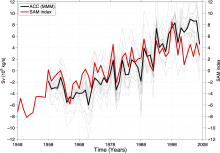
Time-mean and trends for the period 1948-2007 are analysed in a suite of global ocean-sea ice models forced with CORE-II forcing, focusing on the ACC, MOC, water masses and sea-ice evolution.
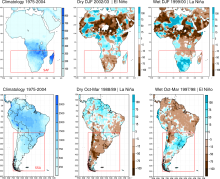
This study shows how climate change due to humans has affected the probability that extreme events in South America and Southern Africa evolved in the way that they did.
The National Environmental Research Council (NERC) Independent Research Fellowship (IRF) Scheme is designed to develop scientific leadership among the most promising early-career environmental scientists, by giving all fellows five years’ support, which will
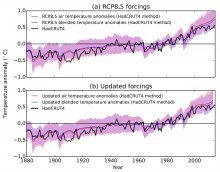
An apples to apples comparison of global temperatures.
When comparing global temperatures estimated from observations with climate model simulations, challenges include issues related to incomplete observational data. Here we quantify the influence of different observational data types.
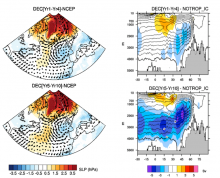
Drifts/biases are often present when climate models are initialized from observed conditions to produce climate predictions.Model drifts are usually removed for skill assessment but they are rarely analysed.

Compared with the not evident increase of Pacific heat content, Indian Ocean heat content has dramatically increased over the "hiatus" period.
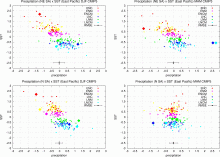
The observed precipitation in South America exhibits significant anomalies when there are strong sea surface temperature anomalies (SSTA) in different parts of equatorial Pacific. The study analyses how models simulate these influences in present day climate simulations.





Subscribe to the CLIVAR monthly bulletin featuring the latest news, events and activities direct to your inbox.
