Science Highlights
Multiyear La Niña does not increase the likelihood of transitioning to a strong El Niño
Submitted by Joana on Tue, 2025-03-11 08:40Figure 1. More persistent cold conditions in boreal spring and early summer after a multiyear La Niña, compared to those before a strong El Niño (left, a, c), inhibit an eastward movement and enhancement of atmosphere deep convection (right, b, d), leading to a decoupled ocean and atmosphere that delay the growth of a subsequent El Niño.
The Influence of Contrasting La Niña Evolutions on Indian Monsoon Rainfall Dynamics
Submitted by Di Zhang on Tue, 2024-12-10 02:55Our CLIVAR member Satyaban Bishoyi Ratna from Climate Dynamics Panel and Monsoons Panel recently published the article which explored two distinct types of evolution in La Niña and the associated asymmetry in the response of the ISMR. It was observed that India receives significantly more and less rainfall during ELLA and LALA events, respectively, and ISMR has a spatial diversity with a northeast-southwest dipole pattern.
The Arctic Marine Heatwave Amplification: A Projected Phenomenon
Submitted by Joana on Wed, 2024-12-04 01:20Coupling is key for the tropical Indian and Atlantic Oceans to boost super El Niño
Submitted by Di Zhang on Mon, 2024-11-04 05:11A member of the CLIVAR Tropical Basin Interaction Research Foci (TBI RF) recently published a paper that highlights the importance of coupled dynamics between the tropical Atlantic and Indian Oceans in shaping and intensifying super El Niño events. Their study, which utilizes a series of global climate model experiments, demonstrates that super El Niño events are driven by a complex interaction among the tropical Atlantic, Indian, and Pacific Oceans. It was observed that while individual effects were weaker and more uncertain, the combined effects were significantly stronger and more reliable. Specifically, the joint influence of the Atlantic and Indian Oceans was found to more effectively drive tropical Pacific warming. This process is linked to the nonlinear characteristics of convective sensitivity: when both oceans impact the Pacific simultaneously, they more effectively promote the eastward expansion of the Pacific warm pool, enhancing tropical Pacific convection and strengthening the Bjerknes feedback loop, ultimately leading to the formation of a super El Niño event.
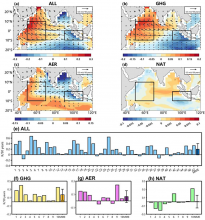
Greenhouse Gases and Aerosols Together Shape a pIOD-like Warming Pattern in the Indian Ocean
Submitted by Yang Zhao on Wed, 2025-07-30 11:47Tropical Pacific Decadal Variability Mechanisms
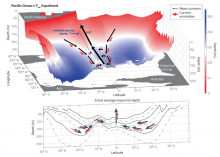
Submitted by admin on Thu, 2024-01-04 08:51The Tropical Pacific Decadal Variability (TPDV) Working Group of the CLIVAR Pacific Region Panel recently published a review paper that evaluates our understanding of the mechanisms behind TPDV. No final consensus exists on the relative importance and efficacy of the mechanisms, but the tropical ocean adjustment to varying wind forcing likely plays a key role in the origin of decadal timescales. These processes are elucidated in this review paper which is a product of rigorous discussions at several virtual meetings over the span of two years since the working group’s establishment in May 2021.
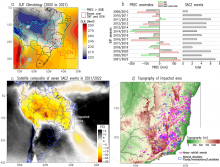
Oceanic SACZ produces an abnormally wet 2021/2022 rainy season in South America
Submitted by Liping Yin on Tue, 2023-03-28 16:01Advection-driven marine heatwaves and co-occurring extremes in the Mozambique Channel
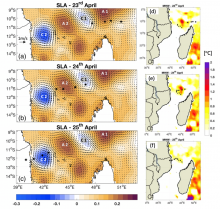
Submitted by Jing Li on Thu, 2023-03-23 02:26Marine heatwaves (MHWs) are events characterized by prolonged and extremely warm ocean conditions, and have been detected in recent decades over many regions of the global ocean. Some recent studies led by D. Mawren and with the contribution from J. Hermes (co-chair of IORP), provide an improved understanding of the important role of horizontal advection, associated with anticyclonic eddies on the evolution of MHWs, as well as the co-occurring extremes in the Mozambique Channel.