


Greenhouse Gases and Aerosols Together Shape a pIOD-like Warming Pattern in the Indian Ocean
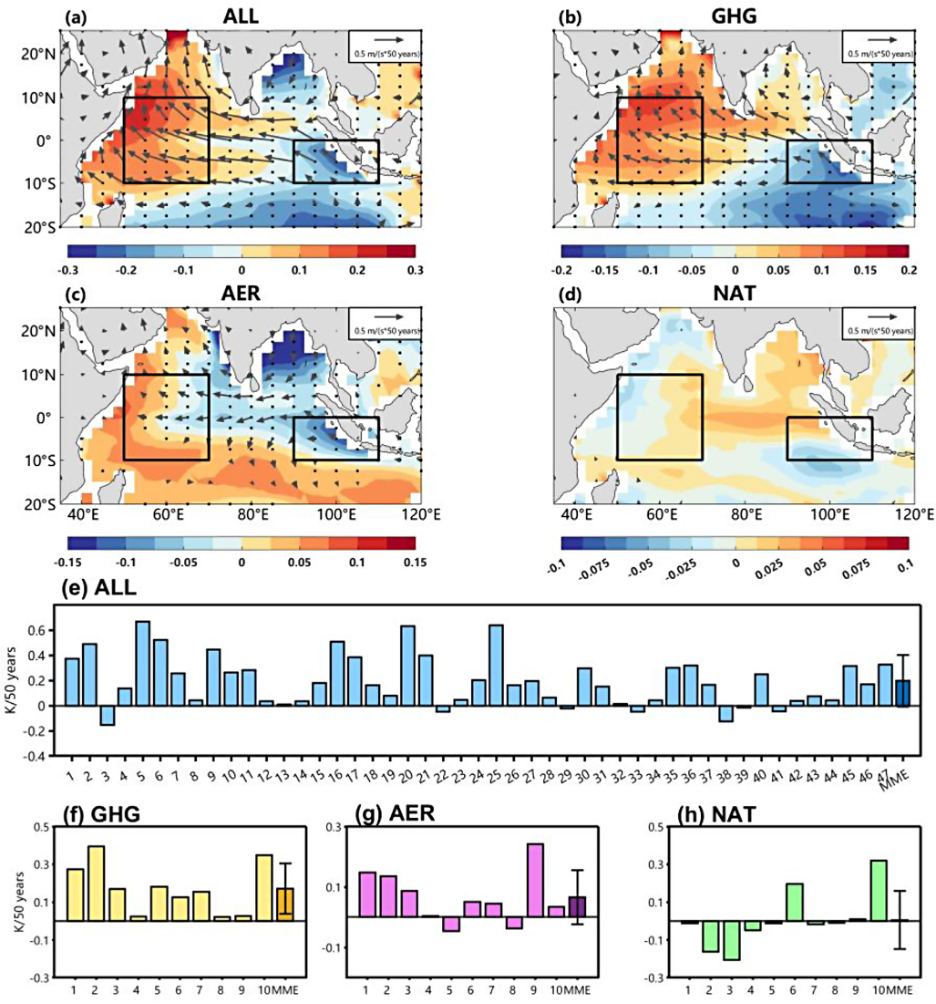
Figure 1: Emergence and attribution of the pIOD-like warming pattern in the tropical Indian Ocean during 1979–2020.
(a–d) Relative sea surface temperature (SST) trends (shading, K 50 years⁻¹) and 10-meter wind trends (vectors, m s⁻¹ 50 years⁻¹) under (a) all-forcing, (b) GHG-only, (c) aerosol-only, and (d) natural-only CMIP6 experiments.
(e–h) Dipole Mode Index (DMI) trends simulated by individual models under the corresponding forcing experiments.
Dotted areas indicate regions with statistically significant SST trends at the 95% confidence level based on the Student’s t-test.
Most climate models project a pronounced positive Indian Ocean Dipole (pIOD)-like warming pattern in the tropical Indian Ocean (TIO) under future warming, characterized by stronger warming in the western basin than in the east. However, whether this pattern has emerged in observations and what drives it has so far remained unclear. A new study published in Climate Dynamics provides compelling evidence that this warming pattern has emerged in observations during 1979–2020, and is primarily driven by external forcing—particularly from greenhouse gases (GHGs) and anthropogenic aerosols.
By analyzing observations, CMIP6 model simulations, and targeted "single-forcing" experiments, the study finds that GHG forcing contributes most significantly to the pIOD-like warming (Fig. 1). This occurs via the weakening of the Walker circulation, which induces anomalous equatorial easterly winds over the Indian Ocean, favoring east-west sea surface temperature (SST) gradients through the Bjerknes feedback.
At the same time, increasing aerosol emissions from South Asia further reinforce this pattern by raising regional sea level pressure, which strengthens equatorial easterly winds via local air-sea coupling. In contrast, during the pre-satellite era (1920–1978), aerosol emissions from Europe and North America induced opposite air-sea responses with westerly winds along the equator, offsetting the GHG effect and leading to a negligible IOD-like warming pattern.
This study highlights the emergent role of external anthropogenic forcing—both global and regional—in shaping the spatial patterns of warming in the Indian Ocean. The findings underscore the need for future projections to consider not only GHGs but also regionally heterogeneous aerosols to understand better and anticipate changes in ocean-atmosphere dynamics and monsoon behavior.
See the article: https://doi.org/10.1007/s00382-025-07710-y
Authors: Shengyao Xin, Lu Dong, Lixin Wu, Fengfei Song, Agus Santoso, Xiaotong Zheng, Bolan Gan, Shichu Liu
Summary by Xuping Gong, edited by Lu Dong