

Other
Fall AGU
Submitted by admin on Wed, 2015-07-29 10:35VECTORS - Understanding what the seas give us
Submitted by LinaKang on Fri, 2015-02-06 03:15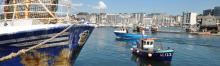
Understanding what the seas give us is central to their future management. New website highlights an innovative approach to a sustainable future for our seas.
Old ice in Arctic vanishingly rare
Submitted by LinaKang on Fri, 2015-02-06 03:01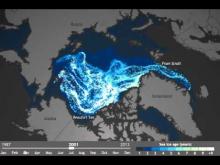
Each winter, sea ice expands to fill nearly the entire Arctic Ocean basin, reaching its maximum extent in March. Each summer, the ice pack shrinks, reaching its smallest extent in September. The ice that survives at least one summer melt season tends to be thicker and more likely to survive future summers. Since the 1980s, the amount of this perennial ice (sometimes called multiyear) has declined.
Tales of future weather
Submitted by LinaKang on Fri, 2015-02-06 02:40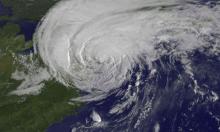
Society is vulnerable to extreme weather events and, by extension, to human impacts on future events. Today a new study by researchers from the Royal Netherlands Meteorological Institute (KNMI) was published in Nature Climate Change. Combining weather models and climate models potentially provides complementary, more realistic and more physically consistent pictures of what future weather might look like. Wilco Hazeleger, Director of NLeSC, is first author of the published study.
Watch a 1,000-Foot-High Wave Move Across the Ocean
Submitted by LinaKang on Fri, 2015-02-06 01:20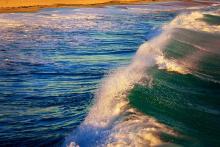
Right now, two research vessels carrying some 40 marine scientists are battling stormy conditions in the Tasman Sea to learn more about gigantic subsurface waves—some 1,000 feet high—that are critical to both ocean health and accurate climate modeling.
The End of the Rainbow - An Open Letter to the Community
Submitted by LinaKang on Sun, 2015-01-25 10:58
An open letter from a group of climate scientists ask for an end to the rainbow colour scale in climate science. The scientists, including NCAS's Ed Hawkins petitions the climate science community in a "A plea to you all to help rid climate science of colour scales that can distort, mislead and confuse. Colour scales that are often illegible to those who are colour blind."
Bin Wang wins The Carl-Gustaf Rossby Research Medal 2015
Submitted by Nico on Sun, 2015-01-25 10:32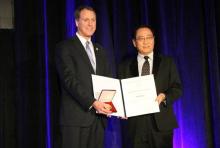
At the 95th Annual Meeting of the American Meteorological Society, the Carl-Gustaf Rossby Research Medal in 2015 was awarded to Prof Bin Wang “for creative insights leading to important advances in the understanding of tropical and monsoonal processes and their predictability”.
A 2000 km Continuous Mission
Submitted by Nico on Sun, 2015-01-25 10:12
The World Climate Research Program (WCRP) is launching a Polar Challenge to reward the first team able to send an Autonomous Underwater Vehicle (AUV) for a 2,000 kilometer mission under the sea-ice in the Arctic or Antarctic.
The aim is to stimulate the development of a sorely-needed monitoring tool for the Polar regions and ultimately to expand scientific research capabilities and climate services in both the Arctic and Antarctic.