

Impacts of coastal upwelling Iron limitation in the Humboldt Current
Impacts of coastal upwelling Iron limitation in the Humboldt Current
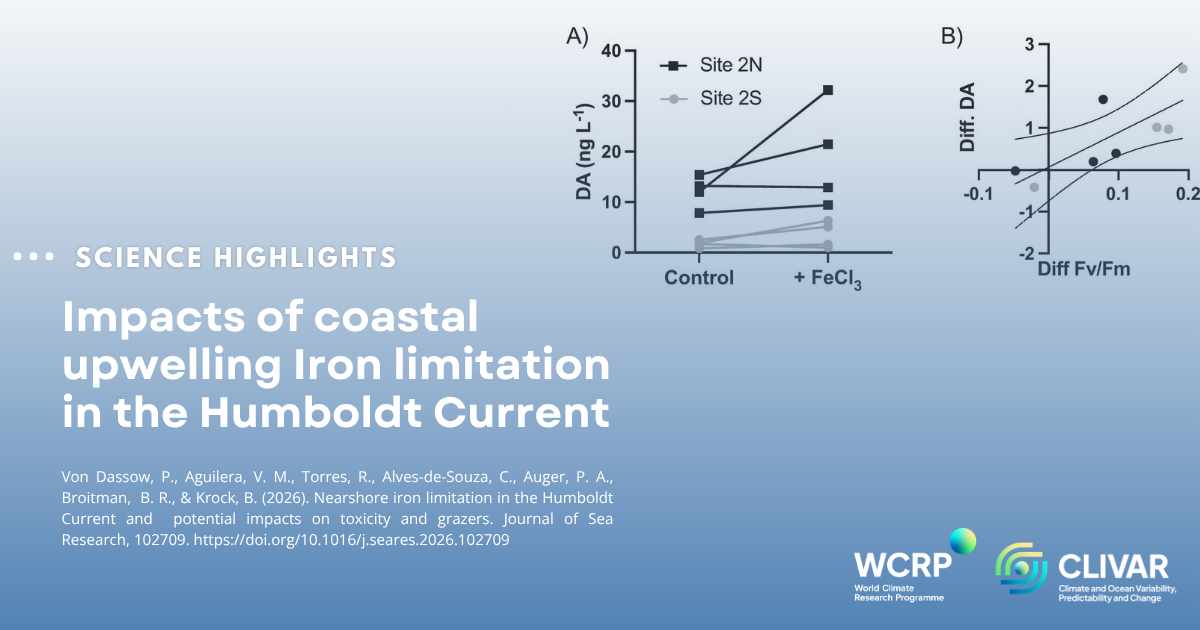
LAOCA Co-chair Dr. Victor Aguilera recently co-authored a study published in the Journal of Sea Research entitled “Nearshore iron limitation in the Humboldt Current and potential impacts on toxicity and grazers”. The southeastern Pacific upwelling system, one of the world's most productive marine ecosystems, supports valuable ecosystem services, including fisheries, aquaculture, carbon sequestration, and the maintenance of marine biodiversity. Despite the high availability of macronutrients supplied by coastal upwelling, this study demonstrates that phytoplankton growth can be constrained by iron supply in nearshore waters of the Humboldt Current. Experimental iron additions stimulated phytoplankton biomass and altered community responses, revealing that iron limitation can occur even in productive coastal environments traditionally considered nutrient-rich. Furthermore, iron enrichment increased domoic acid production by toxigenic diatoms, highlighting that variations in micronutrient supply may influence not only primary productivity but also food-web quality and the occurrence of harmful algal blooms with potential impacts on marine wildlife, fisheries, and human health. These findings have broader implications under ongoing climate change. Because central-northern Chile is experiencing persistent megadrought conditions and increasing exposure of unvegetated soils, atmospheric dust may become an increasingly important vector of iron toward the coastal ocean, where the Chilean scallop (Argopecten purpuratus) aquaculture industry is concentrated. Atmospheric dust has the potential to locally alleviate iron limitation in surface waters. Consequently, future changes in dust emissions and wind regimes may modify coastal productivity, phytoplankton community structure, and toxin production. Although the present study did not directly evaluate atmospheric iron deposition, it identifies iron supply as a key regulator of ecosystem functioning, supporting the hypothesis that increased aeolian iron inputs during drought conditions could become an important driver of biological responses in the coastal Humboldt Current ecosystem.
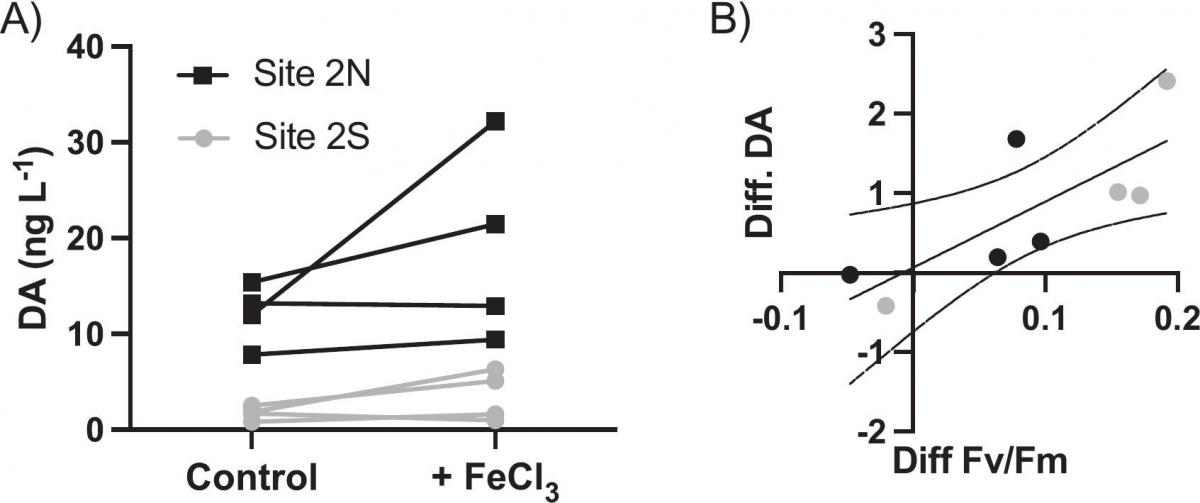
Figure 1. A) DA levels in microcosms from Sites 2S and 2N. Microcosm pairs are indicated by lines. B) The pairwise normalized difference in DA vs difference in Fv/Fm. Lines represent linear regression with 95% confidence interval (R2 = 0.60, p = 0.024).
Reference:
Von Dassow, P., Aguilera, V. M., Torres, R., Alves-de-Souza, C., Auger, P. A., Broitman, B. R., & Krock, B. (2026). Nearshore iron limitation in the Humboldt Current and potential impacts on toxicity and grazers. Journal of Sea Research, 102709. https://doi.org/10.1016/j.seares.2026.102709
(Summary submitted by the author Víctor M. Aguilera.)