

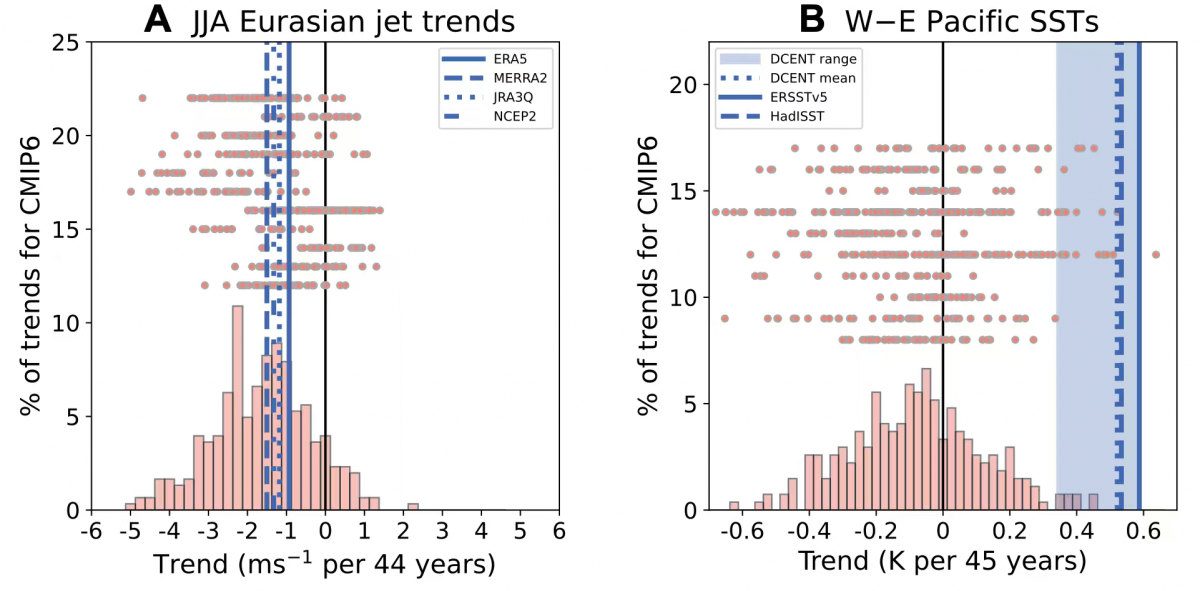
For decades, climate scientists have used numerical Earth System Models (ESMs) to project future climate. The reliability of these projections, relies on the accuracy of models in representing both the transient evolution of anthropogenically forced signals and the dynamics of natural climate variability. In this period of rapid change, long-term trends are now emerging across many variables and their connections to anthropogenically forced climate change versus internal variability are now being assessed using ESMs, placing the modeling community in a unique position to confront ESM trends with observations. This effort must also go hand in hand with understanding of the relative roles of external forcing and natural internal variability in multi-decadal variability in the climate system to ensure that ESMs represent long-term trends and their uncertainties for the correct reasons, allowing for correct attribution of the cause of long-term trends and for improved skill in seasonal to decadal predictions.
This RF will focus the scientific community on the pressing issue of confronting ESMs with observations to assess their representation of long-term trends and multi-decadal variability in the climate system, enhance our understanding of these trends and variability, and ensure that ESMs are capturing these features with fidelity for the correct mechanistic reasons to enhance the reliability of projections and predictions moving forward. This will be achieved through: (1) community analysis of simulations from the forthcoming CMIP7 assessment Fast Track and prior multi-model ensembles such as LESFMIP and high resolution ensembles to evaluate long-term trends and multi-decadal variability and their relative importance; (2) Investigation into the nature of multi-decadal variability over the last millennium in paleo-climate reconstructions; (3) the design and coordination of process-based experiments to understand the diversity of simulated multi-decadal variability and forced responses across models; (4) an overall synthesis of the “state-of-the-signal” - a comprehensive summary of long-term trends, their representation in models, and our current understanding of their origins.
Terms of Reference
The main goal of the RF is to focus international research on identifying and predicting external-forced trends and internally-generated MDV, thereby providing a more informed assessment of projections for the coming decades. More specifically, RF-CEMT-MV will bring together scientists to focus on the following goals:
- Host workshops, webinars, and organize conference sessions to create awareness, synthesize research, and stimulate needed research
- Organize analysis, intercomparison, and coordinated numerical experiments to disentangle forced trends from MDV;
- Devise appropriate methods for assessing the performance of ESMs in predicting trends and MDV across a wide range of variables;
- Advance process level understanding in simulating historical trends and MDV, and foster new approaches to calibrate models predictions/projections;
- Inform on future observational efforts by identifying problem areas where improved process understanding is needed and demonstrating the need for consistent long-term climate records through identification of observational uncertainties;
- Write review/perspective papers to consolidate understanding and guide future research;
- Develop a “State-of-the-signal” summary assessment on the current knowledge of historical trends and the ability of climate models to reproduce them (build on the current “State of the Climate”); Work towards a web-based portal to present this information in an accessible, regularly updated, information with expert guidance on the extent to which ESM’s are accurately representing historical trends.
- hold summer schools and hackathons to educate and interest promising early career researchers from around the world;
- To report annually to CLIVAR.