


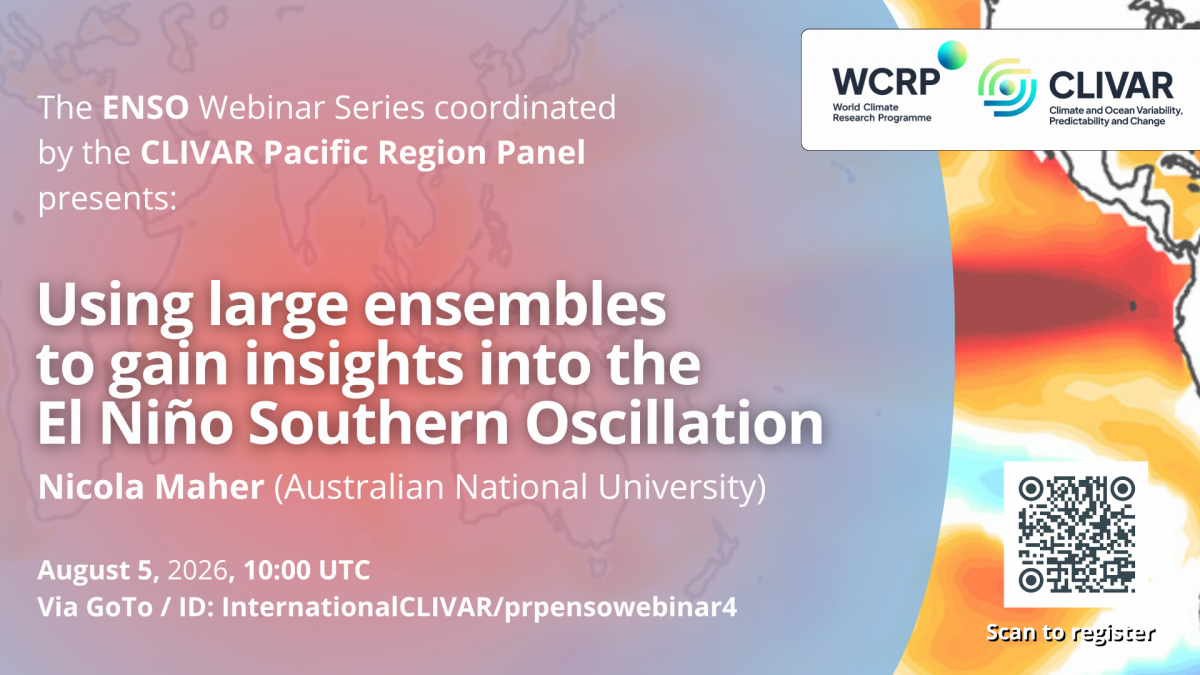
PRP ENSO Webinar No. 4 by Dr Nicola Maher
Submitted by Joana on Tue, 2026-06-09 08:10
Wednesday, August 5, 2026
Event URL:
Event Description:
The Pacific Region Panel invites you to join the fourth edition of its webinar series on ENSO:
Speaker: Nicola Maher - Australian National University
When: August 5, 2026 10:00 UTC
You can Sign up th ENSO Webinars Mailing list here
Abstract:
Single model initial-condition large ensembles (SMILEs) are a powerful tool for separating internal climate variability and forced climate change. SMILEs consist of individual climate models that have been run many times (20-100) under identical external forcing from slightly perturbed initial conditions. Here, I present work that leverages the power of these tools to investigate the El Niño Southern Oscillation (ENSO), using the new multi model large ensemble archive dataset (MMLEAv2). First, I compare observations to SMILEs. Observations can be considered as one realisation of the climate system that we live in. To provide a fair comparison of climate models with observations, one must use multiple realisations or ensemble members from a single model and assess where the observations sit within the ensemble spread. I demonstrate that for highly variable metrics a model might evaluate poorly or favourably compared to the single realisation the observations represent, depending on the chosen ensemble member. Second, I assess the temporal evolution of ENSO SST variability projections and find large model differences. By assessing the evolution of ENSO variability and the mean state in combination, model differences are reduced, highlighting that the models tend to evolve in the same way on varying timescales. Third, I show examples of other research using SMILEs to obtain a more accurate picture of ENSO. This work involves investigating future predictability of ENSO using a model analogues technique. This technique leverages the ensemble size to select ‘similar states’ to any given initial state and create forecasts. Future ENSO predictability is found to be linked to model dependent changes in ENSO SST variability. There is also increased prediction skill before the spring predictability barrier that comes from including the Atlantic and Indian Ocean basins. This suggests a role for important processes outside the Pacific at longer (6-20 month) lead times. Additionally, I present results investigating the risk of high-rainfall events in Australia. These results show an increased future rainfall variance for neutral years, no change for El Niños and increased rainfall for La Niñas. Overall, I demonstrate the power of SMILEs for investigating highly variable phenomenon such as ENSO.
Bio:
Nicola Maher is a Senior Research Fellow at the Australian National University and a Chief Investigator in the Centre of Excellence for the Weather of the 21st Century. She is also a lead author on the upcoming AR7 Intergovernmental Panel on Climate Change report (IPCC). Her research explores the drivers of observed and projected climate change, with a particular focus on large-scale modes of variability such as the El Niño-Southern Oscillation (ENSO). She is interested in understanding how key variables such as temperature and precipitation, those most relevant to global populations, may evolve in a warming climate. Nicola has also contributed to advancing the understanding of uncertainties in climate projections, particularly through the use of single-model initial-condition large ensembles (SMILEs). Her current work focuses on the dynamics, impacts, and future projections of climate variability in the Indo-Pacific Region, and it’s impacts on Australia.
Is external:
All Clivar Events





Comments
JONATHAN PAREDES (not verified)
Tue, 2026-07-21 01:13
Permalink
Recording?
<p>Hi, will the sessions be recorded for those of us who can't join live?</p>
Joana
Wed, 2026-08-05 11:11
Permalink
Recording available
Hi Jonathan, the recording will b available at https://www.youtube.com/@wcrp_clivar/playlists (PRP Webinar Series playlist)
Add new comment