


Emerging Ideas in Climate Dynamics Webinar Series hosted by the CLIVAR Climate Dynamics Panel
Submitted by Di Zhang on Thu, 2026-10-22 02:43
Tuesday, February 16, 2027 to Tuesday, March 23, 2027
Event City:
Online
Event URL:
Event Description:
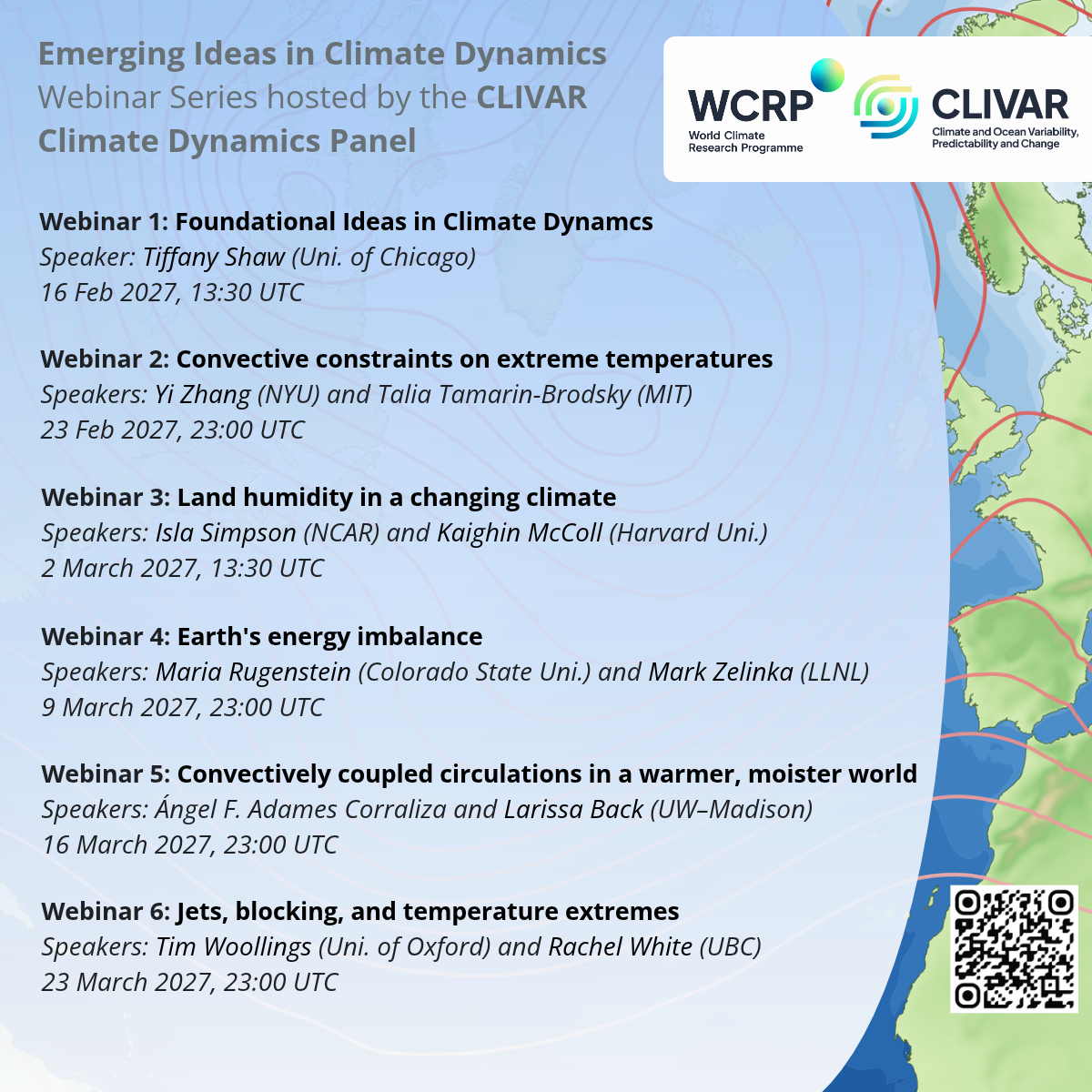
The CLIVAR Climate Dynamics Panel (CDP) will launch a six-part webinar series, Emerging Ideas in Climate Dynamics, in February and March 2027. The series will begin with a one-hour introductory webinar, followed by five 1.5-hour topical webinars exploring emerging research in climate dynamics. Details are provided below.
Save the dates and register for the webinar series via the webpage or QR!
| No | Date | Time (UTC) | Topic | Speakers | Link |
| 1 | Feb 16, 2027 | 13:30 | Foundational Ideas in Climate Dynamcs | Tiffany Shaw (Uni. of Chicago) | Link1 |
| 2 | Feb 23, 2027 | 23:00 | Convective constraints on extreme temperatures | Yi Zhang (NYU) and Talia Tamarin-Brodsky (MIT) | Link2 |
| Blurb: A long-standing theoretical challenge in atmospheric dynamics has been to understand how convection affects and is affected by the large-scale atmospheric circulation. As the world warms, atmospheric humidity and its gradients increase, potentially changing this interaction in ways that matter for understanding future weather and climate. In this webinar, we discuss emerging theories of this scale interaction and how it might change in the future. The transports of energy and moisture by convective clouds are important in all regions of the world, from convectively coupled waves in the deep tropics, to the convection embedded in the warm conveyor belt attached to extratropical cyclones. | |||||
| 3 | March 2, 2027 | 13:30 | Land humidity in a changing climate | Isla Simpson (NCAR) and Kaighin McColl (Harvard Uni.) | Link3 |
| Blurb: Near-surface humidity over land and its response to climate change are fundamentally important for drought, ecosystem functioning, wildfire, and temperature extremes, yet climate models exhibit discrepancies compared to observed land humidity trends and substantial uncertainty in future projections. This webinar explores emerging ideas on how to better understand the distribution of humidity over land and constrain its response to climate change. | |||||
| 4 | March 9, 2027 | 23:00 | Earth's energy imbalance | Maria Rugenstein (Colorado State Uni.) and Mark Zelinka (LLNL) | Link4 |
| Blurb: This webinar explores Earth’s energy imbalance, a fundamental measure of ongoing climate change. Recent observations show a pronounced increase, driven largely by greater absorption of shortwave radiation. Explaining this trend, and disentangling the roles of forcing, feedbacks, and internal variability, requires understanding spatial patterns of energy uptake and coupled atmosphere–ocean dynamics. | |||||
| 5 | March 16, 2027 | 23:00 | Convectively coupled circulations in a warmer, moister world | Ángel F. Adames Corraliza (UW–Madison) and Larissa Back (UW–Madison) | Link5 |
| Blurb: A long-standing theoretical challenge in atmospheric dynamics has been to understand how convection affects and is affected by the large-scale atmospheric circulation. As the world warms, atmospheric humidity and its gradients increase, potentially changing this interaction in ways that matter for understanding future weather and climate. In this webinar, we discuss emerging theories of this scale interaction and how it might change in the future. The transports of energy and moisture by convective clouds are important in all regions of the world, from convectively coupled waves in the deep tropics, to the convection embedded in the warm conveyor belt attached to extratropical cyclones. | |||||
| 6 | March 23, 2027 | 23:00 | Jets, blocking, and temperature extremes | Tim Woollings (Uni. of Oxford) and Rachel White (UBC) | Link6 |
| Blurb: This webinar explores the role of large-scale atmospheric circulation, including jet stream shifts, persistent 'blocking' weather patterns, and Arctic warming, in driving both heatwaves and cold snaps, and how these dynamics are changing as the climate warms. | |||||
Is external:
All Clivar Events






Add new comment