


CLIVAR members at the SynObs Co-Design workshop in Japan, August 24-29
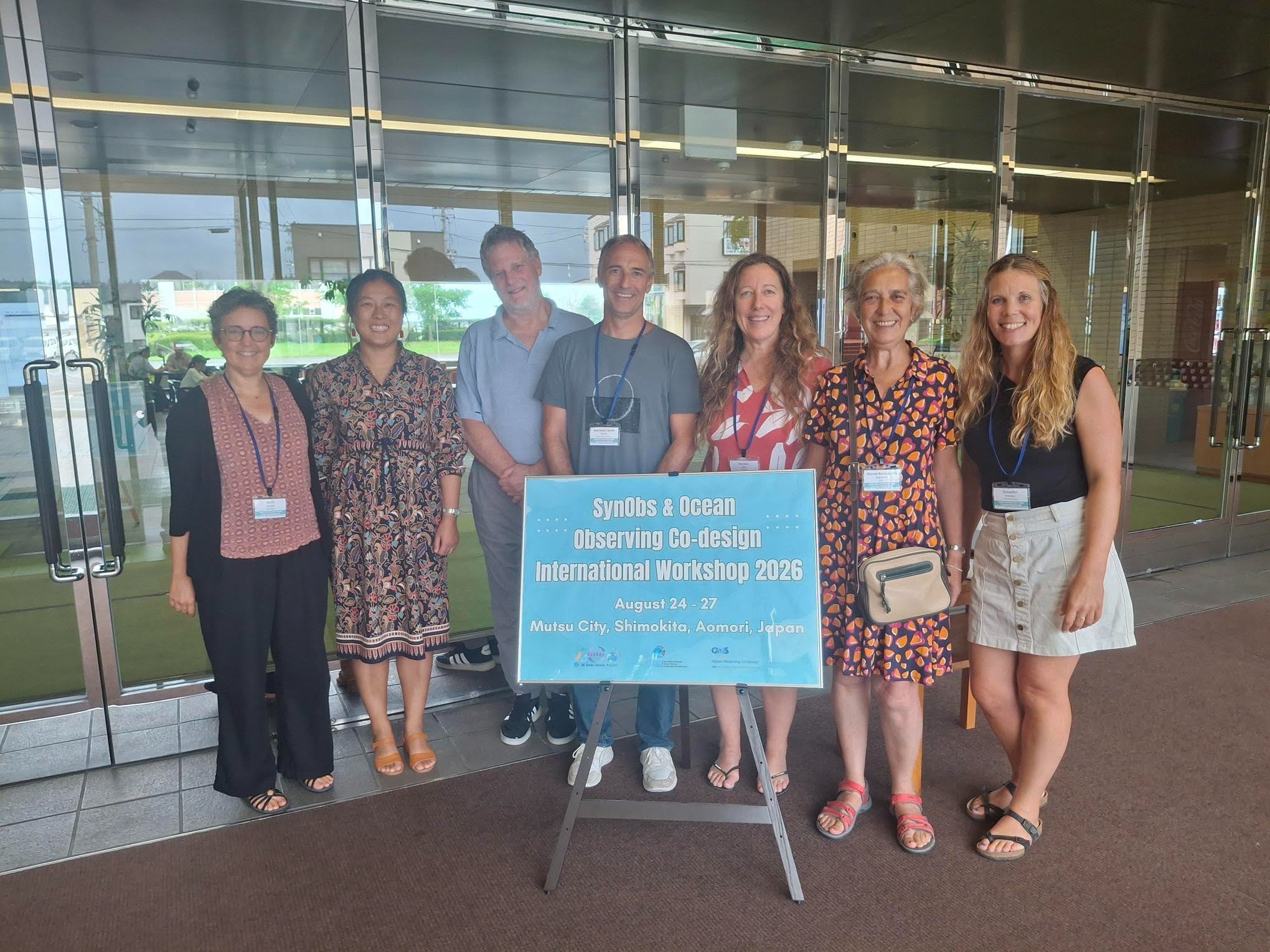
CLIVAR members at the SynObs Co-Design workshop in Japan: Elisabeth Remy (Mercator Ocean International), Chunxue Yang (GSOP member and MER-EP Co-chair), Andrew Peterson (GSOP member), Romaine Bourdalle-Badie (GSOP member and MER-EP Co-chair), Juliet Hermes (CLIVAR SSG, CLIVAR MHWs RF member, and Marine Heatwaves Exemplar Co-design co-chair), Magdalena Balmaseda (CLIVAR SSG and SynObs member), Amandine Schaeffer (MHWs RF member and Marine Heatwaves Exemplar Co-design co-chair)
Evaluating the Ocean Observing System: Insights from SynObs, GOOS Co-Design, and CLIVAR
The CLIVAR Marine Heatwaves Research Focus joined the SynObs and Ocean Observing Co-Design International Workshop in Mutsu, Japan, bringing marine heatwave expertise into discussions on the future of ocean observing systems and their integration with modelling platforms. At the workshop, global ocean modeling and observing communities converged to align multi-system evaluation techniques with user-focused co-design strategies. A key focus was demonstrating how operational ocean data assimilation systems quantify the value of ocean observations across time scales.
Juliet Hermes and Amandine Schaeffer, co-chairs of the Ocean Observing Co-Design Marine Heatwave Exemplar and members of the CLIVAR RF on MHW and SSG, contributed to the workshop’s scientific organisation and discussions, highlighting the importance of marine heatwaves in observation-system design, data assimilation and impact assessment.
Observing System Experiments (OSEs) conducted across multi-system modeling frameworks, following the SYNOBS guidelines, clearly demonstrate how withdrawing specific ocean data streams degrades prediction accuracy. Across global modeling platforms, withholding satellite SST data consistently causes the largest forecast degradations, severely impairing both surface and subsurface temperature accuracy over extended lead times. Similarly, removing profiling floats reduces the capacity to track global Ocean Heat Content (OHC) while increasing medium-range forecast errors for subsurface ocean dynamics and downstream atmospheric conditions. Excluding satellite altimetry likewise degrades assessments of sea surface height and subsurface thermal structures, leading to reduced skill in extended atmospheric predictions. Crucially, these evaluations highlight strong system interdependencies: in-situ profile measurements become significantly more critical when surface satellite coverage is constrained, whereas jointly assimilating surface altimetry and subsurface profiles yields measurable skill gains in forecasting surface air temperatures and sea-level pressure fields. Of particular relevance to the CLIVAR IndOOS panel, a presentation by Xiaojing Li (an external member of the IORP TT QuIndOOS) showed work quantifying the contribution of the Indian Ocean RAMA observing network to seasonal predictions of global Tropical sea surface temperature anomaly, and some ideas as to how to optimize the design.
Integrating Emerging Networks and Regional Co-Design Frameworks
Getting raw ocean observations off a platform and into an operational data assimilation system isn't as simple as plugging in a cable, it takes robust, frictionless data pipelines. While legacy platforms like Argo floats, altimeters, and moorings stream seamlessly via the GTS, newer autonomous tech like gliders historically hit roadblocks simply because of formatting clashes, though updated WMO BUFR templates are finally clearing those hurdles. Pushing into coastal or non-traditional data streams introduces a whole new quality control challenge: ingesting high-frequency profiles from fishing vessels (FVON) or animal-borne sensors (AniBOS) means building custom QC filters, including heavy spatial-temporal thinning and localized depth blocklists to keep coastal noise from throwing off the models. By actively bridging the gap between OCG (Observations Coordination Group) network operators and SynObs modelers, we can systematically clear these data bottlenecks and pull novel observations directly into prediction systems. Ultimately, tying these operational data evaluations directly to GOOS Co-Design Exemplars, as well as CLIVAR regional panels, lets us map global strategy down to local impact.
As always, it was great to interact with members of the climate community and fun to note that Magadalene and Elizabeth both first met at the CLIVAR GSOP meeting in Japan 20 years ago!!
Edited by: Juliet Hermes and Amandine Schaeffer