


ENSO Webinar Series No.2 by Dr Michael McPhaden
Webinar Details
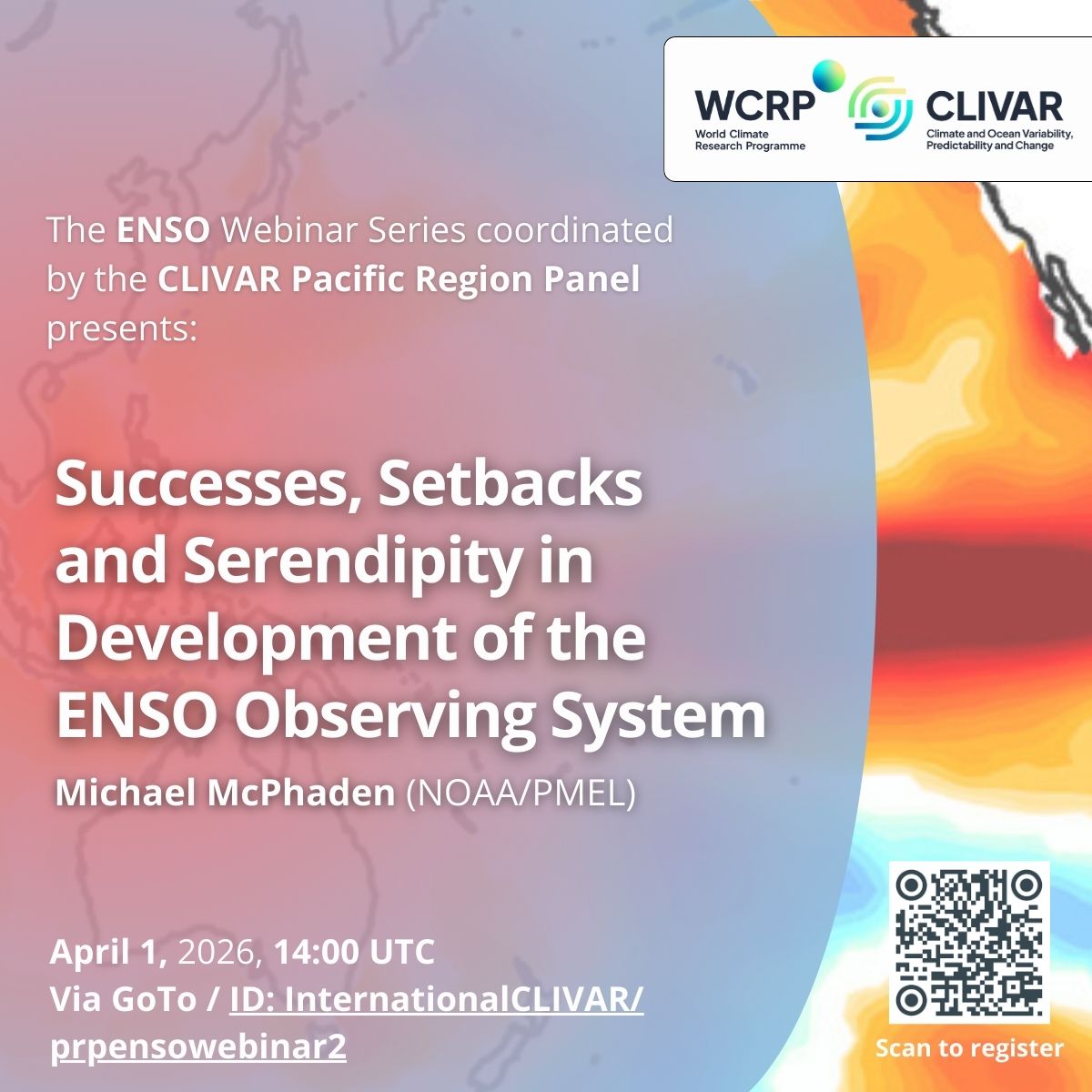
Title: Successes, Setbacks and Serendipity in Development of the ENSO Observing System
Speaker: Michael McPhaden (NOAA/PMEL)
Date: April 1, 2026
Time: 14:00 UTC
You can Sign up th ENSO Webinars Mailing list here
Abstract:
Building an ocean observing system for ENSO research and forecasting has been an ongoing enterprise for more than 50 years. The need for such an observing system was a logical outgrowth of Jacob Bjerknes’ seminal contributions in the 1960s, which initiated the modern era of ENSO research and its applications. The challenge was daunting though, especially in the years before the advent of ocean observing satellites. Success eventually came with establishment of an in situ observing system during the 10-year (1985-94) international Tropical Ocean Global Atmosphere (TOGA) program. This system, the cornerstone of which is the Tropical Atmosphere Ocean (TAO) array, has enabled transformative scientific advances, including a fundamental understanding of ocean–atmosphere interactions that generate ENSO events in the tropical Pacific, the development and validation of coupled ocean–atmosphere seasonal forecast models, and the transition of seasonal climate prediction from an experimental pursuit to an operational capability worldwide. This presentation will: 1) highlight notable advances and setbacks, as well as unexpected and serendipitous events, that shaped the design and implementation of the observing system; and 2) provide illustrative examples of ENSO-related scientific discoveries and breakthroughs enabled by the observing system. We’ll conclude with a discussion of how this system has provided an observational foundation for addressing today’s priorities in ocean and climate science.
Biography:
Michael McPhaden is a Senior Scientist at NOAA’s Pacific Marine Environmental Laboratory in Seattle, Washington. His research focuses on large-scale tropical ocean dynamics, ocean-atmosphere interactions, and the ocean’s role in climate. He received a Ph.D. in Physical Oceanography from the Scripps Institution of Oceanography in 1980. For the past 40 years he has been involved in developing ocean observing systems for climate research and forecasting, most notably the Tropical Atmosphere Ocean
(TAO) moored buoy array in the Pacific for studies of El Niño and the Southern Oscillation.
McPhaden has published over 400 articles in the refereed scientific literature, served as editor-in-chief of the book published in 2021 entitled “El Niño Southern Oscillation in a Changing Climate,” and is one of the most highly cited authors on the topic of El Niño. He is a Nansen Medallist of the European Geosciences Union, a Sverdrup Medallist of the American Meteorological Society (AMS) and a fellow of the AMS, the Oceanography Society, and the American Geophysical Union (AGU). He is also a Past president of AGU, an organization of over 60,000 Earth and space scientists from 140 countries. For his contributions to assessments of the Intergovernmental Panel on Climate Change (IPCC), he shared the Nobel Peace Prize in 2007 with Al Gore and other IPCC participants.





Add new comment