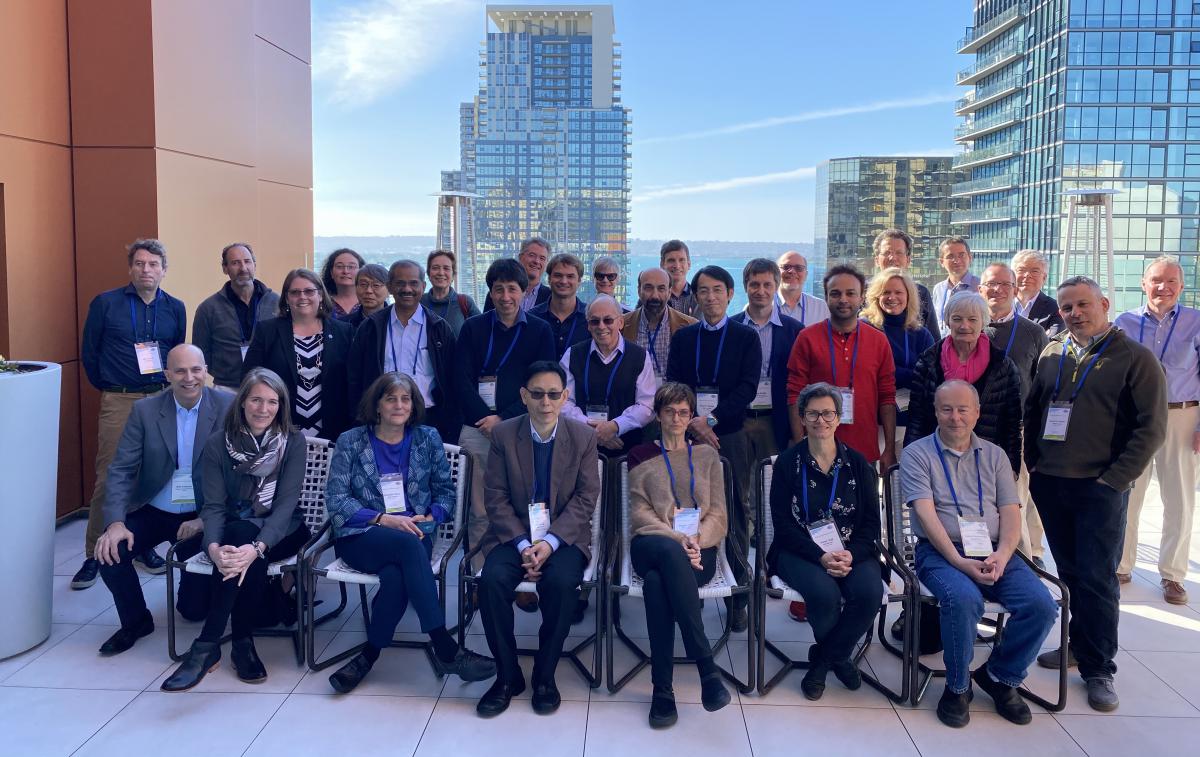
Participants are encouraged to bring posters to the Workshop. Eventhough there will not be a dedicated poster session, boards will be available for informal poster viewing during the Workshop breaks. The preferred format is portrait, with a maximum width of 100cm.
Energetics of the global ocean: the role of layer-thickness form drag
Hidenori Aiki
IPRC/SOEST University of Hawaii Japan Agency for Marine Science and Technology
Kelvin J. Richards (Univ. of Hawaii)
Numerical Solution of the Tides Dynamic Problem
Eugene Botvinovsky
Institute of Numerical Mathematics RAS
Simulation of Upper Ocean thermal structure and Mixed layer variations of the Arabian Sea
Chikka Kalyani Devasena
CSIR-Centre for Mathematical Modelling and Computer Simulation (C-MMACS) Belur Campus Wind Tunnel Road Bangalore-560 037 India
B P.S Swathi Scientist C-MMACS Belur campus Wind Tunnel Road Bangalore-560 037
MARS's behaviour when simulating internal waves
Valerie Garnier
IFREMER DYNECO/PHYSED
Franck Dumas, IFREMER, DYNECO/PHYSED
Ocean circulation sigma-model using splitting numerical technique algorithm
Anatoly Gusev
Institute of Numerical Mathematics (Russian Academy of Sciences)
A. Diansky N.A., B. Gusev A.V. and C. Zalesny V.B. (INM RAS)
Sigma-z Coordinate Model of Enclosed Sea Hydrodynamics for Simulation the Basins with Non-zero Water Budget
Rashit Ibrayev
Institute of Numerical Mathematics, Russian Academy of Sciences
A.A. Romanets (P.P. Shirshov Institute of Oceanology, RAS, Russia)
A new framework for parameterizing eddies in ocean climate models
David Marshall
University of Oxford
Alistair Adcroft (GFDL)
Influence of numerical schemes on current-topography interactions in 1/4° global ocean simulations
Thierry Penduff
CNRS-LEGI
J. Le Sommer (CNRS-LEGI), B. Barnier (CNRS-LEGI), A.M. Treguier (CNRS-LPO), J.M. Molines (CNRS-LEGI), and G. Madec (CNRS-LOCEAN)
Modeling of influence of the Bosporus on vertical biogeochemical structure of the Black Sea
Oleg Podymov
Shirshov Institute of Oceanology RAS, Southern Branch
E.V. Yakushev(Shirshov Institute of Oceanology RAS, Southern Branch, Russia)
Open boundary conditions - idealized case and practical application
Martin Schmidt
Institute of Baltic Sea Reasearch Warnemuende
Michael Herzfeld (CSIRO Hobart ), Zhi Liang (GFDL Princeton)
MOC Varibility estimated using the GECCO Ocean State Estimation
Detlef Stammer
Inst. fuer Meereskunde, Universitaet Hamburg
Armin Koehl
Some riddles about subgridscale parameterizations in ocean circulation models
Remi Tailleux
Walker Institute for Climate System Research University of Reading
An OGCM Study on North Indian Ocean Warming and Sea Level Rise
Bijoy Thompson
Indian Institute of Tropical Meteorology, Pune, INDIA
JayaKumar, C. Gnanaseelan, Anant Parekh and P. S. Salvekar Indian Institute of Tropical Meteorology, Pashan, Pune 411008, India
Improved representation of currents and water masses in the upper layer of the North Pacific Ocean in eddy-resolving OGCMs
Hiroyuki Tsujino
Meteorological Research Institute, Japan Meteorological Agency
Investigation of 2-D and 3-D characteristic-based open boundary conditions for regional ocean models
Frederic Vandermeirsch
IFREMER
E. Blayo (LJK/France), C. Robert (LJK/France), J. Marin (LJK/France), P. Allain (Ifremer/France), F. Dumas (Ifremer/France), V. Garnier (Ifremer/France), L. Debreu (LJK/France)
Preliminary evaluations of a global eddy-permitting OGCM
Fanghua Wu
Division of Climate System Modeling, National Climate Center, Beijing
B. Chan Xiao, C. Qingquan Li and D. Qigeng Zhao (Beijing Climate Center, China Meteorological Administration, Beijing 100081, China)
Modeling of influence of oxygenated inflows in anoxic layers of the Baltic Sea
Evgeniy Yakushev
Southern Branch of Shirshov Institute of Oceanology, RAS
I.S.Kuznetsov (Baltic Sea Research Institute, Warnemuende, Germany)
Energetics of the global ocean: the role of layer-thickness form drag
Hidenori Aiki
IPRC/SOEST University of Hawaii Japan Agency for Marine Science and Technology
Kelvin J. Richards (Univ. of Hawaii)
A set of 3-day snapshots from a high-resolution (0.1 x 0.1 deg) global OGCM is analyzed in the present study by using a low-pass temporal filter in density-coordinates, in order to demonstrate the self-consistency and utility of the adiabatic mean four-box energy diagram (Bleck, 1985; Iwasaki, 2001; Aiki and Yamagata, 2006). In particular we identify the important role of layer-thickness form drag (i.e., residual effects of hydrostatic pressure perturbations). The global distribution of energy conversion done by the layer-thickness form drag turns out to be energy cascade to the perturbation field whose rate is as intense as the works of the eddy-induced overturning circulation and the wind-induced Ekman transport in the world's oceans. The work associated with the vertical redistribution of momentum by the layer-thickness form drag is one order of magnitude larger than that associated with the horizontal redistribution of momentum. The layer-thickness form drag and the eddy-induced velocity are shown to be in near geostrophic balance, resulting in the adiabatic aspects of oceanic dynamics in mid and high latitudes being explained by a set of planetary geostrophic equations. We point out that the vertical redistribution of momentum by the layer-thickness form drag cancels (and reduces) the vertical shear resulting from the eddy-induced overturning circulation (rather than the vertical shear resulting from the surface wind stress). The above results have purely practical implications for the design of mesoscale eddy parameterization in coarse-resolution OGCMs.
Numerical Solution of the Tides Dynamic Problem
Eugene Botvinovsky
Institute of Numerical Mathematics RAS
We examine new approach to the solution of the tides dynamic problem, based on the splitting methods and optimal control theory approaches. At first we apply classical splitting method for the solution of the problem. Next we apply optimal control theory approaches to one of an equations system, obtained after splitting method use. An optimal control problem is formulated for realization of one of the step of the splitting method. We prove that the optimal control problem is well-posed and we suggest an iteration process of the minimization problem. Results of numerical experiments are presented.
The importance of the tropical ocean in influencing global climate is well understood. The Indian Ocean especially the Arabian Sea is unique for many reasons. Further, the monsoon reversals and the resulting currents make it quite unlike other ocean basins. It is a region of intense air-sea interaction and plays a very significant role in climate variability. In this study we try to model the buoy observations using Modular Ocean Model (MOM), a contemporary OGCM. The domain of the model is 38-100 deg East (0.4 resolution),15-27 deg North (0.4 resolution) and 35 levels in the vertical (10m in the top 100 m and 17 m in the top 200 m). We have forced the model with surface observations at the WHOI mooring site in the Arabian sea blended with other data and compared the thermal and salinity structures of the resulting simulation with observations. The model is successful in reproducing observations during January-July 1995, but does poorly during the southwest monsoon. We have analysed model simulations in detail to study the thermal structure and mixed layer variability and the performance of the model at the buoy location in the Arabian Sea.
MARS's behaviour when simulating internal waves
Valerie Garnier
IFREMER DYNECO/PHYSED
Franck Dumas, IFREMER, DYNECO/PHYSED
In the Bay of Biscay, internal waves are the most energetic. They are generated at the top of the shelf break in stratified conditions and propagate both towards the open sea and the coastal area. This process presents high interest because it introduces specific physical dynamics that restrain biological processes. To ameliorate existing physical and biological realistic simulations in the Bay of Biscay with the code MARS (Model for Applications at Regional Scales), we evaluate the generation, propagation and properties of internal waves simulated by the code MARS in idealized conditions : a semi-diurnal tidal waves M2 propagates perpendicular to an analytical shelf break in stratified conditions. The bathymetry and hydrological properties fit realistic conditions encountered in the Bay of Biscay. The barotropic tidal wave, that forces the system, is firstly estimated through the linear assumption following Le Tareau and Maze's methodology [1994]. In a first step, we evaluate MARS's efficiency in resolving the barotropic tidal dynamics. Secondly, we analyse the rectified current over the shelf break introduced by non-linear terms. Finally we discuss preliminary results of simulated internal waves according to vertical discretization, pressure gradients schemes, advection schemes.
Ocean circulation sigma-model using splitting numerical technique algorithm
Anatoly Gusev
Institute of Numerical Mathematics (Russian Academy of Sciences)
A. Diansky N.A., B. Gusev A.V. and C. Zalesny V.B. (INM RAS)
The ocean circulation sigma-model developed in the INM RAS is presented. The model consists of the standard primitive equations and potential temperature and salinity equations solved in spherical sigma-coordinates. The splitting procedures by physical processes and spatial coordinates are used in the numerical realization. It makes it possible to use implicit time integration schemes with large time steps. The method of splitting allows us to introduce the linear shallow water equations for barotropic circulation only at the intermediate stage of splitting. They are solved simultaneously by iterative or direct methods. The lateral diffusion operator is used in the form equivalent to horizontal diffusion. The horizontal pressure gradient is used in the symmetrized form, reducing its finite-difference approximation error in sigma-coordinates. The 4-th order lateral viscosity operator is used, that lets us reduce the 2-th order diffusion coefficients, and therefore, to improve the model performance. Using these features makes it possible to integrate the model for long time periods. The results of experiments carried out with regional version of the model with resolution 0.25x0.25 degrees for Arctic and North Atlantic basin are presented. The global version of the model with resolution 2.5x2.0 degrees is used as the ocean component of the climate system model which is also developed in the INM RAS and presented in the IPCC Fourth Assessment Report. The results of experiments with this OGCM are also presented. An OGCM with higher resolution 0.5x0.25 degrees is now under development.
Sigma-z Coordinate Model of Enclosed Sea Hydrodynamics for Simulation the Basins with Non-zero Water Budget
Rashit Ibrayev
Institute of Numerical Mathematics, Russian Academy of Sciences
A.A. Romanets (P.P. Shirshov Institute of Oceanology, RAS, Russia)
A 3-dimensional primitive equation ocean general circulation model with free sea surface has been developed for simulation of inter-annual variability of thermo- hydro-dynamical processes in enclosed and semi-enclosed seas with non-zero water balance. The peculiarities of such a seas include (i) relatively small water mass and hence (ii) critical importance of air-sea and sea-land interactions for total heat, salt and water mass balances; (iii) water mass variability in the basin and corresponding variability of sea level and coastal line; (iv) large areas of very shallow (O(1m)) regions. We propose model with hybrid sigma-z vertical grid. Model permits large (O(10m)) variations of mean sea level, flooding and drying processes, good resolution of upper mixed layer in deep sea regions, etc. Tests demonstrating the functioning of the model are presented.
A new framework for parameterizing eddies in ocean climate models
David Marshall
University of Oxford
Alistair Adcroft (GFDL)
A new framework is developed for parameterizing eddies in ocean models. The proposed eddy closures flux potential vorticity (or layer thickness) down-gradient along density surfaces and satisfy an energy conservation relation by solving an explicit budget for the eddy energy. The latter is, in turn, related to the eddy transfer coefficient through a simple scaling relation. When energy conservation is satisfied in this manner, the growth or decay of the parameterised eddy energy can be related naturally to the instability or stability of the flow as described by Arnold's first stability theorem. The resultant family of eddy closures therefore possess some of the ingredients necessary to parameterize the gross effects of eddies in both forced-dissipative and freely-decaying turbulence. An important issue concerns parameterization of the dispersion and dissipation of the eddy energy, for which some simple schemes are suggested. These ideas are illustrated through applications to wind-driven circulation and freely decaying turbulence in idealised ocean basins. Preliminary results are also presented from an ocean general circulation model in which the Gent and McWilliams eddy closure is modified to include an explicit eddy energy budget. The resultant parameterized eddy energies are broadly in accord with observed distributions. We suggest that this general conservative approach may prove valuable for parameterizing geostrophic eddies in ocean climate models.
Influence of numerical schemes on current-topography interactions in 1/4° global ocean simulations
Thierry Penduff
CNRS-LEGI
J. Le Sommer (CNRS-LEGI), B. Barnier (CNRS-LEGI), A.M. Treguier (CNRS-LPO), J.M. Molines (CNRS-LEGI), and G. Madec (CNRS-LOCEAN)
The combined use of partial steps and of an energy-enstrophy conserving momentum advection scheme was shown by Barnier et al. (2006) to yield substantial improvements in the surface solution of the DRAKKAR 1/4° global sea-ice/ocean model. The present study extends this investigation below the surface with a special focus on the Atlantic and reveals many improvements there as well: e.g. more realistic path, structure and transports of major currents (Gulf Stream, North Atlantic Current, Confluence region, Zapiola anticyclone), behaviour of shedded rings, narrower subsurface boundary currents, stronger mean and eddy flows (MKE and EKE) at depth, beneficial enhancement of cyclonic (anticyclonic) flows around topographic depressions (mountains). Interestingly, adding a no-slip boundary condition to this improved model setup cancels most of these improvements, bringing back the biases diagnosed without the improved momentum advection scheme and partial steps (these biases are typical of other models at comparable or higher resolutions). This shows that current-topography interactions and full-depth eddy-admitting model solutions can be seriously deteriorated by near-bottom sidewall friction, either explicit or inherent to inadequate numerical schemes.
Modeling of influence of the Bosporus on vertical biogeochemical structure of the Black Sea
Oleg Podymov
Shirshov Institute of Oceanology RAS, Southern Branch
E.V. Yakushev(Shirshov Institute of Oceanology RAS, Southern Branch, Russia)
Black Sea is the world-largest meromictic Sea. The single source of oxygenated water below permanent pycnocline of the Sea is the deep Bosphorus current. In this study we used combined 1D hydrophysical-biogeochemical model based on the General Ocean Turbulent Model (Burchard et al., 1999) and the RedOx Layer Model, (Yakushev et al., 2006). This O-N-S-P-Mn-Fe model allowed to simulate basic features of changes of biogeochemical structure in case of transformation of oxic conditions into anoxic and from anoxic into oxic. We parameterized an intrusion of oxygenated water at the depth of the Bosporus Plume and studied the consequences of this event. The model simulations demonstrated that the influence of the Marmara Sea water influx through the Bosporus can be traced only in the south-western region of the Black Sea (about 200-300 km from the Bosporus). Vertical structure of other regions of the Black Sea is formed mainly because of vertical exchange processes and biogeochemical transformation. Literature: Burchard H., Bolding K. and Villareal M.R. (1999): GOTM, a general ocean turbulence model. Theory, applications and test cases. European Commission report EUR 18745 EN, 103 Yakushev E.V., Pollehne F., Jost G., Kuznetsov I., Schneider B. and Umlauf L.(2006) Redox-Layer Model (ROLM): a tool for analysis of the water column oxci/anoxic interface processes. Meereswissenschaftliche Berichte, Marine Scince Report. No 68. Instutut fur Ostseeforschung Warnemuende. 2006. 54 pp
Open boundary conditions - idealized case and practical application
Martin Schmidt
Institute of Baltic Sea Reasearch Warnemuende
Michael Herzfeld (CSIRO Hobart ), Zhi Liang (GFDL Princeton)
Open boundary conditions (OBC) used in ocean models are mostly mathematically ill-posed. For a one-dimensional, non-rotating channel a well posed boundary condition is given. It is written as radiation condition and serves as a reference to understand skills and shortcomings of applications for a rotating 3-dimensional ocean.
The implementation of OBC in MOM4 is outlined. Three applications of this type of boundary conditions are described, a Baltic Sea model as example for a semi-enclosed sea, a model of the equatorial and south-eastern Atlantic and a regional model of the tropical Pacific forced by a Hurricane passing the model domain.
MOC Varibility estimated using the GECCO Ocean State Estimation
Detlef Stammer
Inst. fuer Meereskunde, Universitaet Hamburg
Armin Koehl
An estimate of the time-varying ocean circulation, obtained over the period 1952-2001 is analyzed here with respect to its decadal and longer term changes in sea level. The estimate results from a synthesis of most of the ocean data sets available during this 50-year period with the ECCO/MIT ocean circulation model. Estimated over the top 750 m depth, the increase in thermosteric sea level rise amounts to 1.3 mm/yr on average over the period 1992 through 2001. This corresponds to an increase in upper ocean heat content of 1.5x10^22 J/yr and is in agreement with estimates of Willis et al. (2004). However, over the period 1962 through 2001 the global net thermosteric sea level rise is estimated as 0.92 mm/yr from top to bottom, which is three times the recent estimate from Antonov et al. (2005) (0.33 mm/yr). For the last decade, the corresponding global heat flux into the ocean of 1.5~W/m is twice as large as the recent estimate by Willis et al. (2004) due to the heat content change in deeper layers. Regional changes in sea level are predominantly associated with an intensification of the subtropical gyre circulation and a corresponding redistribution of heat. The horizontal advection of heat due to an increase in wind stress curl is found to explain a major fraction of the estimated regional sea level trends over the last 40 years. However, the mechanisms appear different during the last decade when changes in surface heat flux may explain as much as 50% of the sea level changes.
Some riddles about subgridscale parameterizations in ocean circulation models
Remi Tailleux
Walker Institute for Climate System Research University of Reading
The purpose of this poster is to examine two particular riddles arising from the second law analysis of turbulent mixing in a stratified fluid. According to this analysis, it is found that: 1) there is no other way for the mechanical forcing or kinetic energy to be converted irreversibly into mean gravitational potential energy other than via dissipation into heat, which is a negligible effect; 2) stratified turbulence should speed up the convergence toward thermodynamic equilibrium. The main consequence of this result is that we should expect the work of expansion/contraction to be a positive term in reality, which in an OGCMs is played by the work of the horizontal velocity against the horizontal pressure. Suprisingly, however, this term is usually found to be negative in realistic geometries, e.g., Toggweiler and Samuels (1998), Gnanadesikan et al. (2005). We suggest that this is so because the work of the bolus velocity associated with the Gent-McWilliams parameterization is not accounted for in the mechanical energy balance; yet, because it is a strongly ageostrophic term, it would be very significant. The second point is that if stratified turbulence brings the oceans faster toward thermodynamic equilibrium, then the usual approach of mixing potential temperature and salinity is not physically justified, as this in effect relaxes the solution toward a different equilibrium.
An OGCM Study on North Indian Ocean Warming and Sea Level Rise
Bijoy Thompson
Indian Institute of Tropical Meteorology, Pune, INDIA
JayaKumar, C. Gnanaseelan, Anant Parekh and P. S. Salvekar Indian Institute of Tropical Meteorology, Pashan, Pune 411008, India
The long term variability in the temperature and sea level over north Indian Ocean during the period 1958-2000 has been investigated in this study. A comprehensive evaluation of recently developed Modular Ocean Model version 4 using sea level observation from Topex/Poseidon (T/P) satellite and in situ temperature observation from WHOI moored buoy and sea surface temperature (SST) observations from DS1, DS3 and DS4 moored buoys has also been performed. The model temperature and sea level anomaly over north Indian Ocean shows an increasing trend in the study period. Long (6-8 years) warming episodes in the SST over north Indian Ocean are observed to be followed by short episodes (2-3 years) of cooling. The model thermocline heat content for unit area shows a linear increasing trend (from 1958-2000) at the rate of 0.0018 x 10¹¹ J/m2 per year, representing a heat content increase of 0.079 x 10¹¹ J/m2 for north Indian Ocean. The increase in net surface heat flux due to the reduction in the release of latent and sensible heat fluxes is the major contributor for this warming. North Indian Ocean sea level anomaly also shows a linear increasing trend of 0.31 mm/year signifying a sea level rise of 13.22 mm during 1958-2000.
Improved representation of currents and water masses in the upper layer of the North Pacific Ocean in eddy-resolving OGCMs
Hiroyuki Tsujino
Meteorological Research Institute, Japan Meteorological Agency
Recent increase in computation power enables us to study a role of small scale processes through eddy-resolving numerical simulations of the ocean circulation. Our research group develops eddy-resolving models of the North Pacific Ocean using Meteorological Research Institute Community Ocean Model (MRI.COM). Using these models, we study mechanism and predictability of the upper layer currents and water masses in the western part of the mid-latitude North Pacific Ocean, which is rich in important oceanic features such as boundary currents, fronts, and eddies. It is found that the overall representation of an eddy-resolving model, whose horizontal resolution is about 10 km, is considerably improved from that of an eddy-permitting model, whose horizontal resolution is about 20 km. In the eddy resolving model, the Kuroshio separates steadily from the Japan coast and the Kuroshio Extension and the inertial recirculation gyre south of it are formed realistically. A process study indicates that the large inertial terms of the momentum equation are crucial for the formation of these processes in the model. The improved current fields result in the improved representation of the water masses such as North Pacific Intermediate Water (NPIW) and Subtropical Mode Water (NPSTMW). The processes associated with the strained structure whose scales are smaller than the typical size of mesoscale eddies also affect the formation process of these water masses. With the aid of data assimilation techniques, an eddy-resolving model is used for the prediction of the Kuroshio path variations, including the large meander, south of Japan. It shows a better skill than the operational system of Japan Meteorological Agency, which is based on an eddy-permitting model.
Investigation of 2-D and 3-D characteristic-based open boundary conditions for regional ocean models
Frederic Vandermeirsch
IFREMER
E. Blayo (LJK/France), C. Robert (LJK/France), J. Marin (LJK/France), P. Allain (Ifremer/France), F. Dumas (Ifremer/France), V. Garnier (Ifremer/France), L. Debreu (LJK/France)
The solution of regional ocean models is generally strongly dependent on the way the model is forced at its open boundaries. This forcing consists of two parts: on one hand, the available boundary data; on the other hand, the open boundary conditions (OBCs), i.e. the mathematical conditions through which the boundary data are provided to the model. It has been shown in a recent study (Blayo and Debreu, 2005) that a key point for the design of relevant OBCs is to consider the fundamental hyperbolic nature of ocean models. The approach consists in using OBCs of the form Bw = Bwext, for each incoming characteristic variable w, where B is a partial differential operator (the simplest choices being the identity or the normal derivative) and wext is the value of w given by the external data. The implementation of such characteristic OBCs is quite simple for the barotropic part of the flow, but is much more difficult for the baroclinic part, since the hydrostatic assumption leads to some loss of hyperbolicity of the momentum equations. It is thus necessary to implement 3-D OBCs using a local vertical modes decomposition. In this poster, we describe the method and present an ongoing study of the implementation of such 2-D and 3-D OBCs in two ocean models: MARS and OPA. Several configurations are presented, both idealized (channel) and realistic (Bay of Biscay and Gulf of Lion). It is shown that the use of characteristic OBCs for the barotropic flow leads to improved results as compared to the other usual OBCs. The tests in the 3-D case are currently underway. Nevertheless, the preliminary results show a reduction in the RMS error, which can be two times lower in some configurations than that obtained using a standard method. The relevance of the characteristics method must now be explored further with more realistic test cases.
Preliminary evaluations of a global eddy-permitting OGCM
Fanghua Wu
Division of Climate System Modeling, National Climate Center, Beijing
B. Chan Xiao, C. Qingquan Li and D. Qigeng Zhao (Beijing Climate Center, China Meteorological Administration, Beijing 100081, China)
To better understand climate variability in East Asia and improve the short-term climate prediction, an eddy-permitting OGCM is established based on MOM4 in Beijing Climate Center (BCC). The OGCM spans the global range and it has 40 vertical levels. The horizontal grid spacing is 1 deg. in longitude. Meridionally, the grid spacing is also 1 deg. outside the tropics but decreases to 1/3 deg. near the Equator for improved resolution of equatorial processes. Real forcing results show that simulated climatology is closed to observation. Interannual signals of the Pacific and Indian Oceans are reproduced reasonably in this model. Further, a two-step shape-preserving advection scheme (TSPAS), which merges the advantages of small dispersion error in the simple first-order upwind advection scheme and small dissipation error in the simple second-order Lax-Wendroff scheme is employed for the tracer equation. Compared with the simulations of the original scheme, the new scheme reduces cold bias in the tropical Pacific cold tongue region and improves equatorial thermocline structure.
Modeling of influence of oxygenated inflows in anoxic layers of the Baltic Sea
Evgeniy Yakushev
Southern Branch of Shirshov Institute of Oceanology, RAS
I.S.Kuznetsov (Baltic Sea Research Institute, Warnemuende, Germany)
Anoxic conditions in water column are a natural feature of many areas in seas. These conditions arise when transport rates of organic matter (OM) and oxygen into deeper layers of seas are not balanced and oxygen is used-up leaving an excess of organic material to be decomposed. Anoxic zone that presents in the Baltic Sea significantly affects its ecological state. In this study we used combined 1D hydrophysical-biogeochemical model based on the General Ocean Turbulent Model (Burchard et al., 1999)) and the RedOx Layer Model, (Yakushev et al., 2006). This O-N-S-P-Mn-Fe model allowed to simulate basic features of biogeochemical structure changes in case of transformation of oxic conditions into anoxic and from anoxic into oxic. We studied influence of oxygenated intrusions on the vertical biogeochemical structure of the Sea. The model simulations demonstrated that: Intensification of the redox reactions and growth of bacteria during the inflows development leading to an increase of particulate matter content and acceleration of sedimentation. During the inflow events large amounts of iron and manganese precipitate. Variability of the redox interface depth in the Gotland Deep of the Baltic Sea is determined by frequency and intensity of intrusions of the North Sea water. Literature: Burchard H., Bolding K. and Villareal M.R. (1999): GOTM, a general ocean turbulence model. Theory, applications and test cases. European Commission report EUR 18745 EN, 103 Yakushev E.V., Pollehne F., Jost G., Kuznetsov I., Schneider B. and Umlauf L.(2006) Redox-Layer Model (ROLM): a tool for analysis of the water column oxci/anoxic interface processes. Meereswissenschaftliche Berichte, Marine Scince Report. No 68. Instutut fur Ostseeforschung Warnemuende. 2006. 54 pp