WCRP logo
CLIVAR logo
CLIVAR
CLIMATE VARIABILITY AND PREDICTABILITY

International CLIVAR Project Office
National Oceanography Centre
European Way
Southampton, SO14 3ZH, UK
Phone: +44-2380 596777
Fax: +44-2380 596204
Email:

JSC/CLIVAR Working Group on Coupled Modelling

News | Terms of reference | Members | Activities | CMIP | Regional Modelling | Projects | Publications

Working Group on Coupled Modelling 11th Session

September 3-5 2007, Hamburg, Germany


The 11th Session of the WCRP/CLIVAR Working Group on Coupled Modelling will meet at the Max Planck Institute for Meteorology (MPI) in Hamburg, Germany, on September 3-5 2007.

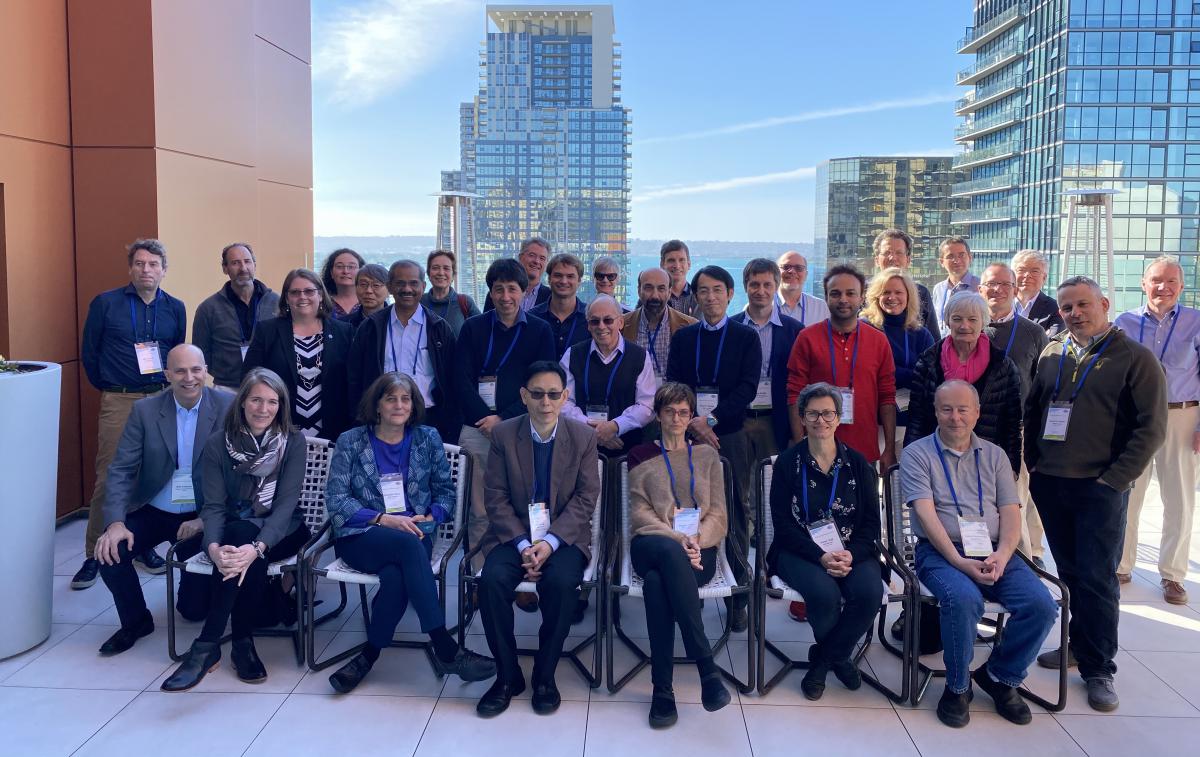
Please see below for the provisional agenda, a note to all particpants,and reports submitted before the meeting. A list of participants is available here.

Venue:

The WGCM meeting will take place in the "ZMAW" building at Bundesstr. 53. This is the new greenish building next to the high-rise "Geomatikum" building, where the ICESM conference takes place. The WGCM meeting will be held on the ground floor of the ZMAW building in room 022/023. Detailed information on the location of the building and the access by plane or train is available in the Venue link of the International Conference on Earth System Modelling (ICESM) webpages.

Contacts:

Anna Pirani
Venkataramaiah Satyan

Contact at MPI:

Ms Barbara Zinecker
Assistant to Prof. Dr. Martin Claussen
Max Planck Institute for Meteorology
Bundesstrasse 53
D-20146 Hamburg
Phone: +49 (0)40 41173 226
Fax: +49 (0)40 41173 350
Email: barbara.zinecker@zmaw.de
web: www.mpimet.mpg.de

Hotel reservations

Information on hotels in Hamburg is also available through Hotels/Tourism link of the ICESM webpages.

The first link in the "Hotel Reservations" paragraph opens the "Hamburg Tourism Agency" web site, with the possibility for hotel online booking, and a wealth of information for visitors. The second link gives a list of hotels close to MPI.

Banquet

MPI-M will organize a conference dinner (either on Monday or Tuesday evening). Information on its location will be made available at the meeting.

Information on Hamburg

http://en.wikipedia.org/wiki/Hamburg


Agenda (provisional)

download pdf

DAY 1 - Monday, September 3

0900-0910 Welcome - J. Mitchell, G. Meehl

-Introductions
-Times, local arrangements - M. Giorgetta
-Explanation of Agenda - J. Mitchell

Adoption of Agenda

0910-0930
Reports and news from governing groups (JSC/CLIVAR) (5 minutes each)

-JSC-XXVIII session, Zanzibar, Tanzania - G.Flato
-CLIVAR SSG session and International CLIVAR Project Office - G. Meehl
-ACC: reports from Beijing, Paris Meetings - G.Flato or other JSC Member/J. Mitchell
-Modelling Summit - TBD

0930-1030
Updates on proposed coordinated experiments and science input relevant to the science questions related to the short term and long term experiments (follow-up to WGCM Victoria meeting, 2006)
(15 minute talks, 5 minutes questions)

-Review proposed strategy for coordinated experiments addressing short term andlonger term climate stabilization (note ENSEMBLES activity) - G. Meehl

-Review responses from modelling groups and input from others in the community (e.g. IDAG) regarding experimental design - J.Meehl, G. Hegerl

-Other possible experiments to test feedbacks in the experimental design - K. Taylor, P. Friedlingstein

1030-1050 Coffee break

-WGSIP input on the short-term decadal experiments, issues related to coupled initialization, ENSO in AOGCMs, and other issues related to WGCM - T. Stockdale

-Perspective on the long term stabilization experiments, status of benchmark stabilization concentration scenarios (Snowmass meeting outcomes, preview upcoming Netherlands meeting, including relevant input on proposed experimental design from TGICA and scenarios consortium, interface with WG2 community) - N. Nakicenovic

-Working Group on Numerical Experimentation WGNE perspective on coordinated experiments, especially the higher resolution short-term experiments, and other issues directly related to WGCM - M.Miller/K. Taylor

-Working Group on Ocean Modelling (WGOMD) including any input on proposed short term and long term coordinated experiments, appropriate resolution, etc. - H. Banks

-Coupled initialization and associated science questions related to the short term decadal prediction problem - J. Murphy

1230-1345 Lunch

1345-1530
Discussion of issues for WGCM (leader in brackets)
(15 minute talk, 5 minute questions)

--Improving climate models

-Cloud climate feedbacks, aerosols - (S.Bony)

-Carbon cycle climate feedbacks:
(1) long term stabilization experiments
(2) strategy for reduction of uncertainties - (C. Le Quéré)

-Metrics: How do we show how well (or poorly) climate models work - (K.Taylor)

--High impact or emerging uncertainties

-Ice sheets and sea level - (J. Gregory)

-Air quality and climate change - (V. Eyring)

1530-1600 Coffee break

1600-1720
Discussion of issues for WGCM (leader in brackets)
(15 minute talk, 5 minutes questions, cont'd)

--Serving the impacts community:

-Regional downscaling for short term and long term (F. Giorgi)

-Decadal prediction: latest developments in the modeling community, and application to impacts (M. Giorgetta)

-Impacts and the next set of coordinated experiments (lead?)

-WGCM's input to WCRP SBSTA paper on Climate Modelling needs for regionalization - (A.Henderson-Sellers)

1720-1745
Recap of day's session and discussion of topics to be re-visited in the next 2 days


DAY 2 - Tuesday, September 4

0900-1030
Updates from modelling centres (including where are the modeling groups in their development cycles related to the proposed experimental design, both classes of models or just one, computing issues related to the large number of experiments proposed)
(12 minutes each, 3 minutes questions)

-Germany - M. Giorgetta
-France - P. Bracannot/S. Bony
-Canada - G. Flato
-Italy - F. Giorgi
-Australia - A. Hirst
-Japan - M. Kimoto

1030-1100 Coffee Break

-U.K. - J. Mitchell
-NCAR - G. Meehl
-GFDL - S. Griffies

1145-1230
WGCM activities

Coupled Model Intercomparison Project (CMIP) - R.Stouffer,C.Covey, K.Taylor, D. Bader

-Current status of CMIP3 multi-model dataset and analysis efforts
-CFMIP next steps ( anything not discussed under clouds and aerosols)
-How will model output from the next set of coordinated experiments be archived and accessed?

1230-1345 Lunch break

1345-1405
WGCM activities (continued)

Paleoclimate Modelling(including relative to climate sensitivity, sea level if not already discussed) - P. Braconnot

1405-1545
Discussion topics

-Role of EMICs to complement AOGCMs and ESMs, especially to interpolate between benchmark scenarios; pattern scaling - (J. Mitchell lead)

-Computer resources required for coordinated experiments - (G. Meehl lead)

1545-1615 Coffee break

1615-1715
Discussion topics (cont.)

-Revisit experimental design in light of outstanding science or logistical considerations - (J. Mitchell lead)

1715-1745
Recap of day's session, and discuss topics for discussion Wednesday

Evening Dinner hosted by MPI


DAY 3 - Wednesday, September 5

0900-1030
Review of decisions, requests to projects etc, and future directions

1030-1100 Coffee break

1100-1230
Review linkages with WGSIP, WGNE, AIMES, WG2, WG3, and others

1230-1345 Lunch break

1345-1530
Recap of session, and re-visit any topics that need further consideration

1530-1600 Coffee break

1600-1700
Closed session

-Membership issues
-Next Session: venue, dates

1700 End of WGCM-11 Session


Note to Participants

This year there is a change in the philosophy of participation by members and experts. Your participation is very much to be focussed on the issues facing/directly relevant to WGCM and helping us solve them, not just reporting on all your activities. There are partial exceptions to this: the sister groups WGNE and WGSIP and the reports on activities at the members' institutions.

The WGCM agenda has become very crowded in the last few years because of the ever increasing interest in climate change, and the development of more comprehensive climate models which include an increasing number of aspects of the full climate system. This year we have changed the form of the agenda to allow us to focus on the main priorities in improving simulations of climate and climate change and guide invited experts in how they can best help with those priorities. These priorities will also be communicated to the JSC, so that they can encourage and co-ordinate work across WCRP, especially in the projects, to improve climate modelling and the prediction of anthropogenic climate change in particular. This year the main items for discussion, which reflect the general emphasis on anthropogenic climate change, are:

1. Emissions scenarios for IPCC

2. Improving climate models

-Cloud climate feedbacks, aerosols
-Carbon cycle climate feedbacks
-Metrics: how do we show climate models work?

3. Serving the impacts community

4. Regional downscaling

5. Decadal prediction

6. High impact or emerging uncertainties

-Ice sheets and sea level
-Extreme events
-Air quality and climate change

For comments by WGCM:

UNFCCC Nairobi Work Programme: WCRP Response to Climate modelling, scenarios and downscaling

The Cloud Feedback Model Inter-comparison Project - Plans for CFMIP-2 - M. Webb et al.


Reports

There will not be time for all invited experts to give a separate talk, but we would very much like everyone to submit a short document-preferably one page with bullet points - on the work of the group they represent which is relevant to these topics. We will also allow more time for debate on the key topics and we will depend very much on invited experts to contribute to the discussion of the key topics and help us to progress. We are also keen that they encourage their group or project to initiate work, where appropriate, to help advance our progress and reduce uncertainties and to report back to the next WGCM meeting.

All speakers please note that the speaking slots are 15 minutes, and we'll be enforcing the time limit. That will leave 5 minutes for questions for each.

NOTE: Deadline for submission of 1-pager reports: 9 August 2007.

Submitted Reports

Author Title

T. Stockdale

WGSIP-related points for WGCM

E. Guilyardi

Understanding ENSO in coupled GCMs: devising a community strategy

G. Tselioudis

GMPP Contribution to WGCM Focus Topics

J. Gregory

Ice Sheets and Sea Level

H. Banks & S. Griffies

WGOMD input on discussion items at WGCM

M. Kimoto

Update on Japanese activities on climate projection

G. M. Flato

Brief report on Anthropogenic Climate Change (ACC) cross-cutting activity

C. Le Quéré

Report on carbon cycle research for WGCM

S. Bony

Cloud Feedback Model Intercomparison Project - Phase 2 (CFMIP2)

G.M. Flato

Brief report on JSC XXVIII, Zanzibar, Tanzania, 26-30 March 2007

A. Hirst

Summary of work at BMRC and CSIRO on the priority areas

K. Taylor

Benchmark experiments for feedback analysis

K. Taylor

Maximizing the Value of Community-Coordinated Experiments with AOGCMs and ESMs

K. Taylor

WGNE: Workshop on Systematic Errors in Climate and NWP Models

K. Taylor

Contribution from performance metrics for climate models

K. Taylor & D. Bader

The multi-model CMIP3 dataset

G.A. Meehl

Global coupled climate model activities (CCSM) at NCAR

G. Hergel

1. Update on new attribution results and questions these raise about model accuracu; 2. Int. Detection and Attribution Group (IDAG) suggestions on design of 20th century simulations for next IPCC

P. Braconnot

Contribution of palaeoclimate to the improvement of climate modelling


last updated Thu, Aug 30, 2007 by Anna Pirani