WCRP logo
CLIVAR logo
CLIVAR
CLIMATE VARIABILITY AND PREDICTABILITY

International CLIVAR Project Office
National Oceanography Centre
European Way
Southampton, SO14 3ZH, UK
Phone: +44-2380 596777
Fax: +44-2380 596204
Email:

Pacific Panel Workshop

Pacific Implementation Panel

News | Terms of reference | Members | Activities | Publications | ENSO Forecasts | SPICE |

CLIVAR Workshop on Western Tropical Pacific: Hatchery for ENSO and Global Teleconnections

Guangzhou CHINA, 26-28 November 2007

Sponsored by:

Chinese Academy of Science, National Natural Science Foundation of China, WCRP, US CLIVAR

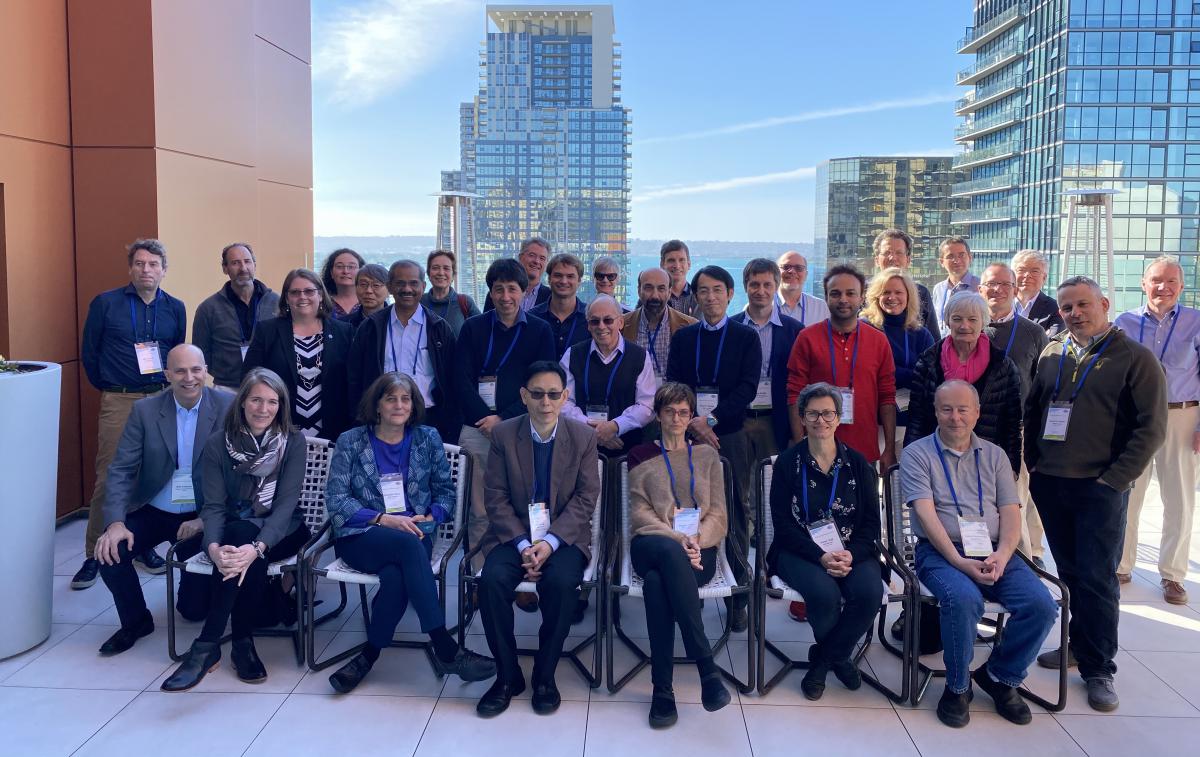
1st row from left: F.-F. Jin, R. Zhang, G. Fang, Y. Ding, H. Hendon, J. Ren, A. Timmerman, R. Mechoso, D. Hu, S. Zhang, Y. Yuan, G. Wu, T. Yamagata, C. Li, D. Chen, Q. Liu, D. Wang, Wendong.
2nd row from left: D. Zhao, G. Feng, C. Li, M. Lengaigne, K. Richards, L. Li, R. Boscolo, B. Crawford, L. Wu, G. Han, B. Qiu, C. Wang, F. Wang, WenZhou, H. Yan, S. Shang, L. Zeng, G. Wang, G. Qiong.
3rd row from left: Q. Zhang, L. Dong, K. P. Sooraj, J. Liang, S. McGregor, Q. Liu, X. Xiao, Y. He, W. Cai, W. Zhou, T. Qu, D. Yuan, X. Shang, G. Ping, H. Yuan, D. Tang, H. Xu, D. Sui, A. Ganachaud.
4th row from left: Z. Wen, X. Wang, W. Duan, S. Wang, R. Ying, S. Power, M. Balmaseda, R. Martinez, J. Zhisu, H. Zhang, S. Tang, X. Shi, G. Wang.
5th row from left: H. Mao, J. Song, D. Shi, H. Ma, Y. Shu, J. Hu, Z. He, X. Yang, H. Zhou, X. Yu, C. Qiu, J. lan, G. Chen, T. Suga, K. Ando, L. Li, J. Chen, C. Xu, T. Yan, J. Tong, W. Wang.
last row from left: M. McPhaden, C. Zhang, M. Collins


Objectives

1. Address key science questions, such as:

- Does the South China Sea play an important role in the climate system or is it merely responding to Pacific/Indian forcing?
- How important is the South China Sea Throughflow in draining heat out of the Pacific?
- Is it possible to improve the prediction of the onset and decline of ENSO?
- What have been the global impacts of the latest ENSO events?
- How does society make use of ENSO predictions?
- How does the long-term Indian ocean warming and Pacific warm pool affect the global climate system (including ENSO)?
- What is the link between MJO, ENSO and mean state?
- What is the origin of the long-term Indian ocean warming and extension of Pacific warm pool?
- How does the warm pool respond to anthropogenic climate change (atmospheric versus oceanic feedbacks)?

2. Further engage the Chinese oceanographic and climate research community in CLIVAR

3. Link the Chinese observational activities to other international field programs (such as SPICE, NPOCE and PACSWIN)

4. Seek international coordination in terms of field experiment timing and infrastructure (sharing ships, common XBT lines, ...), large scale modeling projects, ocean, atmosphere and coupled.


Tentative Program

Day 0. Sunday 25th November 2007

16:00 - 19:00

Registration at Ramada Pearl Hotel front desk

Day 1. Monday 26th November 2007

Kai Xuan Conference Room (Ramada Pearl Hotel 3rd floor)

8:30 - 8:40

Opening by Prof. Yeli Yuan and Dr. Dongxiao Wan

8:40 - 8:50

Introduction and charge to the workshop by the chair of the CLIVAR Pacific Panel (A. Timmermann)

SESSION 1: South China Sea: an important climate player? (Conveners: J. Gan, L. Li and T. Qu)

8:50 - 9:10

ENSO events and climate in China (Y. Ding)

9:10 - 9:30

Recent progress in understanding the South China Sea circulation and climate (D. Wang)

9:30 - 9:50

Interocean circulation and heat and freshwater budget of the South China Sea (G. Fang)

9:50 - 10:10

South China Sea throughflow (T. Qu)

10:10 - 10:40

Break and Photo

10:40 - 11:00

The winter jet along the western boundary of the South China Sea (L. Li)

11:00 - 11:20

Toward the understanding of circulation dynamicsin the South China Sea (J. Gan)

11:20 - 11:40

Sea level and circulation variability and ENSO implications in the South China Sea (G. Han)

11:40 - 12:00

Generation of mesoscale eddies in the eastern South China Sea (G. Wang)

12:00 - 12:20

Responses of phytoplankton ecosystem to the environmental changes in the South China Sea (D. Tang)

12:20 - 13:50

Lunch at California Cafe (Ramada Pearl Hotel 1st floor)

SESSION 2: Indian Ocean - Pacific connections (Conveners: B. Qiu, T. Yamagata and L. Wu)

13:50 - 14:10

NPOCE: Thoughts on Northwestern Pafici Ocean Circulation Experiment (D. Hu)

14:10 - 14:30

Western tropical pacific teleconnections to the northeast Pacific (B. Crawford)

14:30 - 14:50

Pacific decadal oscillation and transport of low potential vorticity water from the central north Pacific toward Taiwan island (Q. Liu)

14:50 - 15:10

Factors affecting changes to the upper ocean in the western equatorial Pacific on intraseasonal to interannual timesacale (K. Richards)

15:10 - 15:30

Indian-Pacific ocean connection: a perspective from climate dynamics (T. Yamagata)

15:30 - 15:50

Global warming, climate variability and Atlantic hurricanes (C. Wang)

16:00 - 17:30

Organized visit to the South China Sea Institute of Oceanology, CAS

18:00 - 20:00

RECEPTION (Dinner Party) at Pearl River Lounge (Ramada Pearl Hotel 1st floor)

Day 2. Tuesday 27th November 2007

Kai Xuan Conference Room (Ramada Pearl Hotel 3rd floor)

SESSION 2 (continue): Indian Ocean - Pacific connections (Conveners: B. Qiu, T. Yamagata and L. Wu)

8:30 - 8:50

Impacts of Land distribution on the air-sea interaction over the IAPO area (G. Wu)

8:50 - 9:10

Toward the understanding of tropical Pacific-Indian ocean climate variability using partial coupling modeling (L. Wu)

9:10 - 9:30

What controls the Indo-Pacific oceanic teleconnections (W. Cai)

9:30 - 9:50

SPICE: a concept for a south Pacific ocean and climate circulation experiment (A. Ganachaud)

9:50 - 10:10

VOCALS: a program of studies of the southeast Pacific climate (R. Mechoso)

10:10 - 10:40

Break and Poster Session

10:40 - 11:00

Long wave dynamics of the Indian Ocean Dipole events (D. Yuan)

11:00 - 11:20

Japanese observational research programs in the north Pacific: W-PASS and SUPRFISH (T. Suga)

11:20 - 11:40

Stommel's box model of thermohaline circulation revisited (Y. Guan)

11:40 - 12:00

Is interdecadal sea level rise in South China related to an early winetr cooling in East Asia? (W. Zhou)

12:00 - 13:30

Lunch at California Cafe (Ramada Pearl Hotel 1st floor)

13:30 - 15:00

DISCUSSION TIME ON SESSIONS 1 & 2 (Chairs: B. Qiu, J. Gan and T. Qu)

- Download outline of discussion on the climate relevance of the South China Sea (ppt by D. Wang)

- Download outline of discussion on Indo-Pacific observations (pdf by B. Qiu)

15:00 - 15:30

Break and Poster Session

SESSION 3: MJO - ENSO Interactions (Conveners: F.-F. Jin and A. Timmermann)

15:30 - 15:50

The MJO anomaly over the equatorial western Pacific and occurrence of El Nino (C. Li)

15:50 - 16:10

ENSO's sensitivity to past and future climate change (A. Timmernann)

16:10 - 16:30

Onset and termination of El NINO events in CGCMS: coupled processes and stochastic forcing (M. Lengaigne)

16:30 - 16:50

Variations in ENSO activities (F. -F. Jin)

16:50 - 17:10

MJO-ENSO connection on interannual to interdecadal timescales (C. Zhang)

18:00 - 20:00

Dinner at California Cafe (Ramada Pearl Hotel 1st floor)

Day 3. Wednesday 28th November 2007

Kai Xuan Conference Room (Ramada Pearl Hotel 3rd floor)

SESSION 3 (continue): MJO - ENSO Interactions (Conveners: F.-F. Jin and A. Timmermann)

8:30 - 8:50

The role of stochastic forcing in ensemble forecasts of the 1997/98 El Nino (H. Hendon)

8:50 - 9:10

On the predictabilty and dynamics of westerly wind bursts in the equatorial Pacific (E. Tziperman)

SESSION 4: ENSO Variability and predictability: the changing face of ENSO? (Conveners: R. Martinez, M. Balmaseda and D. Chen)

9:10 - 9:30

Impact of ocean initial conditions on seasonal forecasts skill (M. Balmaseda)

9:30 - 9:50

Performance of seasonal forecasts along South America during 2006-07 El Nino period: progress, challenges and the impacts on society (R. Martinez)

9:50 - 10:10

Evolution of the 2006-07 El Nino: Role of large scale dynamics and intraseasonal forcing (M. McPhaden)

10:10 - 10:40

Break and Poster Session

10:40 - 11:00

Coupled varibility and predictability in a stochastic climate model of tropical Atlantic (F. Wang)

11:00 - 11:20

El Nino predictions and predictabilty (D. Chen)

11:20 - 11:40

Tropical Pacific signature of global warming (G. Vecchi)

11:40 - 12:00

Climate change and ENSO: current status and future research directions (M. Collins)

12:00 - 13:30

Lunch at California Cafe (Ramada Pearl Hotel 1st floor)

13:30 - 13:50

ENSO and global warming (S. Power)

13:50 - 14:10

Change of the euphotic zone depth in response to 2006/07 El Nino in the tropical west Pacific and the South China Sea (S. Shang)

14:10 - 14:30

Understanding El Nino in ocean-atmosphere general circulation models (E. Guilyardi)

14:30 - 14:50

Improved ENSO ensemble hindcasts by assimilating both SST and altimetry data into an intermediate coupled model using Ensemble Kalman filter (F. Zheng)

14:50 - 15:10

Interdecadal changes in ENSO nonlinearity (A. Soon-Il)

15:10 - 15:40

Break and Poster Session

15:40 - 17:10

DISCUSSION TIME ON SESSIONS 3 & 4 (Chairs: F.-F. Jin and R. Martinez)

- Download Outline for discussion on MJO-ENSO Interactions (ppt by A. Timmermann)

- Download Outlines for discussion on ENSO prediction and ENSO societal impacts (ppt by M. Balmaseda and R. Martinez)

18:30 - 20:10

Boat Tour

Posters:

- CLIVAR in the Pacific (R. Boscolo)
- Evolution and in situ observation of Vietnam cold eddy in summer 2007 (J. Hu)
- The importance of the South China Sea (SCS) throughflow to the climate variability of the Indo-Pacific region (Q. Liu)
- Impact of el-Nino onset timing on the Indian ocean-pacific coupling and subsequentel-Nino evolution (K. P. Sooraj)
- Recent progress in the triton buoy project (K. Ando)
- The role of equatorial/offequatorial wind stress forcing in a hybrid coupled model of the equatorial Pacific Ocean (S. McGregor)


Organizing Committee

Dr. Dongxiao Wang (co-Chair, South China Sea Institute of Oceanology, Chinese Academy of Sciences, Guangzhou, China)
Prof. Yeli Yuan (co-Chair, First Institute of Oceanography, State Oceanic Administration, Qingdao, China)
Bo Qiu (Uni. Hawaii, USA)
Magdalena Balmaseda (ECMWF, UK)
Axel Timmermann (IPRC-Uni. Hawaii, USA)
Rodney Martinez (CIIFEN, Equador)
Roberta Boscolo (ICPO, Spain)

Local Organizing Committee

Dr. Dake Chen (Second Institute of Oceanography, State Oceanic Administration, Hangzhou)
Prof. Yihui Ding (National Climate Center, China Meteorological Administration, Beijing)
Dr. Jianping Gan (University of Science and Technology, Hong Kong)
Prof. Ronghui Huang (Institute of Atmospheric Physics, Chinese Academy of Sciences, Beijing)
Prof. Chongyin Li (Institute of Atmospheric Physics, Chinese Academy of Sciences, Beijing)
Prof. Li Li (Third Institute of Oceanography, State Oceanic Administration, Xiamen)
Dr. Ping Shi (South China Sea Institute of Oceanology, Chinese Academy of Sciences, Guangzhou)
Prof. Guoxiong Wu (Institute of Atmospheric Physics, Chinese Academy of Sciences, Beijing)
Dr. Lixin Wu (College of Physical and Environmental Oceanography, Ocean University of China, Qingdao)
Dr. Weidong Yu (First Institute of Oceanography, State Oceanic Administration, Qingdao)
Dr. Renhe Zhang (Chinese Academy of Meteorological Sciences, China Meteorological Administration, Beijing)
Dr. Jiang Zhu (Institute of Atmospheric Physics, Chinese Academy of Sciences, Beijing)


Venue

The workshop will be held at the Ramada Pearl Hotel Guangzhou

The hotel is located in the eastern part of Guangzhou beside the Pearl River amidst a tranquil and relaxing environment. It is only 5 kilometers away from the Guangzhou-Hong Kong Express Railway Station and 40 kilometers from the Baiyun International Airport and there's only 15 minutes to Pazhou International Convention Exhibition Centre (Canton Fair).

Places of interest nearby: Baiyun Mountain, China Trade Fair Site, Ching Ping Wet Market, Dr. Sun Yat-Sen Memorial, Luhu Golf & Country Club, Masters Golf Club, Panyu Safari Park, Tianhe Sports Stadium, Er Sha Island.


Accomodations

A block booking have been made at the following hotels:

The Ramada Pearl Hotel (9 Mingyue Yi Road, Guangzhou Main Road Central)
special rate for workshop attendees (breakfast included): 550RMB/night for a single room and 610RMB/night for a double room

Moon Bay Hotel (18 Mingyue Yi Road, Guangzhou Main Road Central)
special rate for workshop attendees (breakfast included): 260RMB/night for a single or double room

Please send the details of your reservation to Victor Wu (ledy@scsio.ac.cn) and Roberta Boscolo (rbos@iim.csic.es) no later tahn November 15th.


Registration and Abstract Submission

The workshop is open to any interested scientist and student however there is a limit in the total number of attendees. For this reason registration is required to better establish logistical details.

Please complete the registration form and submit your abstract (same form) by 30th September 2007

A registration fee of 800RMB (~100USD) will be collected at the workshop venue

If you have any queries or are experiencing problems please contact:
Roberta Boscolo (rbos@iim.csic.es)
International CLIVAR Project Office
tel. +34 986 231930 ext 374
Fax +34 986 292762


last updated 31 December, 2007 by Roberta Boscolo